ISC (Science)
Academic Year: 2024-2025
Date & Time: 7th March 2025, 2:00 pm
Duration: 3h
Advertisements
Instructions to Candidates:
- You are allowed an additional fifteen minutes for only reading the question paper.
- You must NOT start writing during reading time.
- This question paper has 11 printed pages and one blank page.
- There are twenty questions in this paper. Answer all questions.
- There are four sections in the paper: A, B, C and D. Internal choices have been provided in two questions each in Sections B, C and D.
- Section A consists of one question having fourteen sub-parts of one mark each.
- While attempting Multiple Choice Questions in Section A, you are required to write only ONE option as the answer.
- Section B consists of seven questions of two marks each.
- Section C consists of nine questions of three marks each.
- Section D consists of three questions of five marks each.
- The intended marks for questions are given in brackets [ ].
- A list of useful constants and relations is given at the end of this paper.
- A simple scientific calculator without a programmable memory may be used for calculations.
USEFUL CONSTANTS AND RELATIONS
| 1. | Speed of light in vacuum | c | = | 3 × 10⁸ ms−1 |
| 2. | Charge of a proton | e | = | 1.6 × 10⁻¹⁹ C |
| 3. | Mass of a proton | mp | = | 1.67 × 10⁻²⁷ kg |
| 4. | Permeability of vacuum | μ0 | = | 4π × 10−7 kg |
| 5. | 1 nm | = | 10−9 m | |
| 6. | π | = | 3.14 |
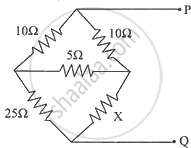
When a battery is connected between the terminals P and Q, as shown in Figure below, it is found that no current flows through 5Ω resistor. Then, the value of resistor X is:
10Ω
20Ω
25Ω
45Ω
Chapter:
The relative permeability of substance ‘X’ is slightly less than one and that of substance ‘Y’ is slightly more than one. Then ______.
‘X’ is paramagnetic and ‘Y’ is ferromagnetic.
‘X’ is diamagnetic and ‘Y’ is ferromagnetic.
‘X’ is paramagnetic and ‘Y’ is diamagnetic.
‘X’ is diamagnetic and ‘Y’ is paramagnetic.
Chapter:
If kinetic energy of moving electrons is made four times, then their de Broglie wavelength becomes ______.
eight times
four times
two times
half
Chapter:
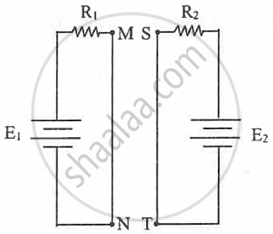
A student has made connections, as shown in Figure below, so that the wires MN and ST repel each other. But it is observed that they are attracting each other. What change should the student make for the wires to repel each other?
Reverse the terminals of batteries E1 and E2.
Reverse the terminals of battery E1 or E2.
Choose supply voltage such that E1 = E2.
Add key and ammeter to the circuit.
Chapter:
N-type semiconductor is that which has ______.
majority of holes as charge carriers.
majority of free electrons as charge carriers.
trivalent element added as an impurity.
an equal number of holes and free electrons.
Chapter:
Assertion: When a convex lens made of glass is completely immersed in water, its focal length increases.
Reason: Refractive index of glass with respect to water is greater than that of glass with respect to air.
Both Assertion and Reason are true and Reason is the correct explanation for Assertion.
Both Assertion and Reason are true but Reason is not the correct explanation for Assertion.
Assertion is true and Reason is false.
Both Assertion and Reason are false.
Chapter:
Assertion: Diffraction of light is difficult to observe in everyday situations but can be observed in laboratory conditions.
Reason: To produce diffraction of waves, size of an obstacle must be comparable to the wavelength of the waves.
Both Assertion and Reason are true and Reason is the correct explanation for Assertion.
Both Assertion and Reason are true but Reason is not the correct explanation for Assertion.
Assertion is true and Reason is false.
Both Assertion and Reason are false.
Chapter:
Answer the following question briefly:
How does the resistance of a semiconductor crystal vary with its temperature?
Chapter:
Answer the following questions briefly:
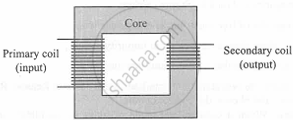
Figure below shows an ideal transformer. Explain why current flowing through secondary coil is greater than that in primary coil.
Chapter:
State any one difference between a primary rainbow and a secondary rainbow.
Chapter:
Answer the following question briefly:
Hubble telescope employs a large parabolic mirror as an objective. State any one advantage of using a mirror in place of a lens in such a telescope.
Chapter:
State any one phenomenon in which moving particles exhibit wave nature.
Chapter:
Answer the following questions briefly:
What is the minimum energy a gamma ray (γ) photon should possess to produce an electron-positron pair?
Chapter:
Answer the following questions briefly:
In an energy band diagram of a certain material, forbidden band is absent. Identify this material.
Chapter:
What is the effect on capacitance of a parallel plate capacitor if the distance between its plates is increased?
Chapter:
Advertisements
How will capacitance of a capacitor change if a dielectric slab is introduced between its plates?
Chapter:
Figures 4 and 5 represent the combination of two identical cells having negligible internal resistance.
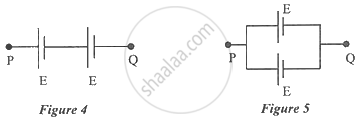
- In which of the two combinations, emf of the battery is greater?
-
When a resistor ‘R’ is connected between the terminals P and Q, I1 and I2 are the currents flowing through ‘R’ in Figure 4 and Figure 5 respectively. Obtain the ratio `I_1/I_2`.
Chapter:
In case of a short electric dipole:
What is the locus of a point having zero potential?
Chapter:
In case of a short electric dipole:
If electric field intensity at a point in axial position is E1 and at an equidistant point in equatorial position is E2, what is the ratio `E_1/E_2`?
Chapter:
Figure 6 below shows an electric circuit.
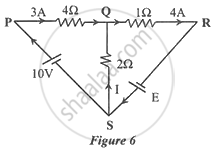
Apply Kirchhoff’s laws to calculate:
- current ‘I’ flowing through the 2Ω resistor.
- emf of the cell ‘E’.
Chapter:
In a potentiometer arrangement, a cell of emf 1.25 V gives a balance point at 35.0 cm length of the wire. If the cell is replaced by another cell and the balance point shifts to 63.0 cm, what is the emf of the second cell?
Chapter:
Magnetic field at the centre of a circular coil is B. Calculate the magnetic field at the same point when each of the current, number of turns of the coil and its radius is doubled.
Chapter:
The objective of a telescope consists of two lenses kept in contact. One lens has an optical power of +2.0 D whereas the other lens has an optical power of −1.5 D. Calculate focal length of the objective.
Chapter:
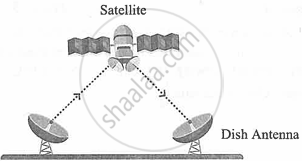
- Name the electromagnetic wave travelling from the satellite to the dish antenna shown in the image above.
- If the wavelength of an electromagnetic wave is 6nm, what is its frequency?
Chapter:
With reference to photoelectric effect, define the term Threshold frequency.
Chapter:
With reference to the photoelectric effect, define the term work function.
Chapter:
An infinite plane metallic sheet having surface charge density ‘+σ’ is placed in vacuum. P is a point at a small distance ‘r’ to its right.
- Write an expression for intensity of electric field at point P.
- Now, an identical charged sheet having surface charge density ‘−σ’ is placed parallel to the first sheet such that the point P is to its left at the same distance ‘r’. (The point P lies between the two plates.)
- What is the resultant intensity of electric field at point P?
- What is its direction?
Chapter:
Harry sets up a circuit as shown in Figure 7 below. He measures potential difference ‘V’ across the variable resistor R with an instrument Y. He also measures current ‘I’ flowing through R with another instrument X.
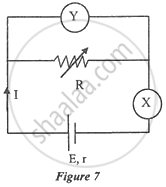
- Identify the instruments X and Y.
- Using the graph of V against I shown below, calculate
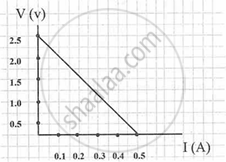
- emf (E) of the cell.
- Internal resistance (r) of the cell.
Chapter:
The graph below shows the variation of current density (J) with electric field (E) applied to two different metallic wires A and B.
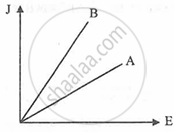
- Which one of the wires, A or B, has higher resistivity?
- For a certain value of electric field (E), in which wire ‘A’ or ‘B’ is drift velocity greater? Give a reason for your answer.
Chapter:
A galvanometer having a resistance of 20 Ω shows a full scale deflection with a current of 1 mA. How can it be converted into a voltmeter with a range of 0-10 V?
Chapter:
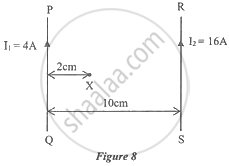
Two infinitely long straight wires PQ and RS carrying currents I1 and I2 respectively are kept 10 cm apart in vacuum. Calculate magnetic field (B) at the point X shown in Figure 8 below.
Chapter:
Advertisements
An electron and a proton are moving along the +X axis. If an external magnetic field B = 0.314 T is applied along −Z axis:
- What is the path followed by the electron due to the magnetic field?
- Calculate the frequency of revolution of the proton.
Chapter:
A convex lens having small focal length is to be used as a magnifying glass (simple microscope) to obtain an image of a small diamond. If the image lies at least distance of distinct vision (D):
- Where will you keep the diamond to obtain its image at D?
- State any two characteristics of the image formed by the magnifying glass.
Chapter:
A parallel beam of light is travelling obliquely from an optically rarer medium to an optically denser medium.
- Draw a labelled diagram showing incident and refracted wavefronts. Mark angle of incidence as ‘i’ and angle of refraction as ‘r’.
- Use Huygen’s wave theory to prove Snell’s law.
Chapter:
For any prism, show that refractive index ‘n’ of its material is given by:
n = `(sin((A + delta m)/2))/(sin(A/2))`
where the terms have their usual meaning.
Chapter:
Two identical rectangular slits 5 mm apart are illuminated with a monochromatic light of wavelength 600 nm. The screen is kept 1.2 m away from the slits.
- Calculate the distance between the 5th bright fringe (band) on one side and the 3rd bright fringe on the other side of the central bright band.
- What will be the change in the interference pattern if the given light is replaced with monochromatic light of wavelength 500 nm?
Chapter:
- Plot a labelled graph of stopping potential (Vs) versus frequency (f) of incident UV radiation.
- State how the value of Planck’s constant can be determined from this graph.
Chapter:
Figure 9 shows a metallic rod MN of length l = 3 m moving in an external uniform magnetic field, B = `(1/pi)T` which is directed into the plane of this paper.
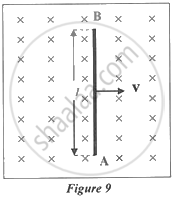
If the position of the rod changes with time as x = πt, where x is in meter and t is in second, then:
- Calculate the motional emf developed in the rod.
- Name the law used to find the direction of induced current.
Chapter:
When current flowing through a solenoid decreases from 15 A to 0 in 0.2 s, an emf of 30 V is induced in it. Calculate the coefficient of self-inductance of the solenoid.
Chapter:
An alternating emf E = 5.0 Sin(314 t)V is applied to a circuit containing a resistor connected in series with an unknown component X.
The current in the circuit is found to be I = `3.0 sin(314t - pi/3)A`
- Identify the component X.
- Calculate rms value (Ir m s) of the current flowing through the circuit.
- Find the frequency of the source.
- Calculate power factor.
- Find the impedance (Z) of the circuit.
Chapter:
Show that radius (rn) of the nth Bohr orbit varies directly with square of the principal quantum number (n) of the orbit.
Chapter:
Where does nuclear fusion reaction take place continuously in the Universe?
Chapter:
A group of students went on an educational tour of Bhabha Atomic Research Centre, Mumbai. They visited various nuclear reactors like Apsara, Cirus, Zerlina and Dhruv and observed that Apsara was a swimming pool type reactor. The teacher explained how water slows down fast moving neutrons and absorbs the heat produced in the reactor.
- What is the use of a nuclear reactor?
- What is the name given to a material which slows down fast moving neutrons?
- State how a nuclear reactor can be shut down in case of an emergency.
Chapter:
What is meant by the statement ‘Angular momentum of an orbiting electron is quantised’?
Chapter:
What is the physical significance of the fact that total energy of an orbiting electron is negative?
Chapter:
When a television set (scientifically known as a television receiver) is opened, many components like semiconductor diodes, transistors, capacitors, resistors etc. can be observed on its motherboard. There are different types of diodes like photo diode, Zener diode, LED etc. found in the T.V. set. With the help of these components, a television receives audio as well as video signals.
- A semiconductor diode has two types of semiconducting materials: ‘P’ type and ‘N’ type. What is the difference between them? [2]
- Draw a labelled diagram of a full wave rectifier. Show graphically how its output voltage varies with time. [2]
- What type of diode can be used as a voltage regulator? [1]
Chapter:
Other Solutions
Submit Question Paper
Help us maintain new question papers on Shaalaa.com, so we can continue to help studentsonly jpg, png and pdf files
CISCE previous year question papers ISC Class 12 Physics (Theory) with solutions 2024 - 2025
Previous year Question paper for CISCE ISC Class 12 -2025 is solved by experts. Solved question papers gives you the chance to check yourself after your mock test.
By referring the question paper Solutions for Physics (Theory), you can scale your preparation level and work on your weak areas. It will also help the candidates in developing the time-management skills. Practice makes perfect, and there is no better way to practice than to attempt previous year question paper solutions of CISCE ISC Class 12.
How CISCE ISC Class 12 Question Paper solutions Help Students ?
• Question paper solutions for Physics (Theory) will helps students to prepare for exam.
• Question paper with answer will boost students confidence in exam time and also give you an idea About the important questions and topics to be prepared for the board exam.
• For finding solution of question papers no need to refer so multiple sources like textbook or guides.
