Advertisements
Advertisements
प्रश्न
Two non-ideal batteries are connected in parallel. Consider the following statements:-
(A) The equivalent emf is smaller than either of the two emfs.
(B) The equivalent internal resistance is smaller than either of the two internal resistances.
विकल्प
A and B are correct
A is correct but B is wrong
B is correct but A is wrong
A and B are wrong
Advertisements
उत्तर
B is correct but A is wrong
The equivalent emf \[\epsilon_0,\] when two non-ideal batteries of emfs \[\epsilon_1\] and \[\epsilon_2\] and internal resistances r1 and r2 respectively are connected in parallel to each other, is given by:-
\[\epsilon_0 = \frac{\epsilon_1 r_1 + \epsilon_2 r_2}{r_1 + r_2}\]
Thus, the equivalent emf is greater than either of the emfs. Thus, statement A is wrong.
For the parallel combination of the batteries of internal resistance r1 and r2, the equivalent internal resistance r is given as
\[r = \frac{r_1 r_2}{r_1 + r_2}\]
Thus, the value of the resultant resistance is even smaller than either resistance.
APPEARS IN
संबंधित प्रश्न
Two identical cells of emf 1.5 V each joined in parallel, supply energy to an external circuit consisting of two resistances of 7 Ω each joined in parallel. A very high resistance voltmeter reads the terminal voltage of cells to be 1.4 V. Calculate the internal resistance of each cell.
A battery of emf 10 V and internal resistance 3 Ω is connected to a resistor. If the current in the circuit is 0.5 A, what is the resistance of the resistor? What is the terminal voltage of the battery when the circuit is closed?
A long straight current carrying wire passes normally through the centre of circular loop. If the current through the wire increases, will there be an induced emf in the loop? Justify.
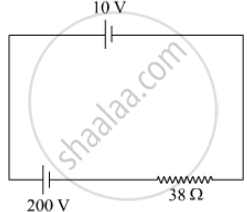
A 10 V cell of negligible internal resistance is connected in parallel across a battery of emf 200 V and internal resistance 38 Ω as shown in the figure. Find the value of current in the circuit.
A resistor R is connected to a cell of-emf e and internal resistance r. The potential difference across the resistor R is found to be V. State the relation between e, V, Rand r.
Plot a graph showing variation of voltage vs the current drawn from the cell. How can one get information from this plot about the emf of the cell and its internal resistance?
A rectangular conductor LMNO is placed in a uniform magnetic field of 0.5 T. The field is directed perpendicular to the plane of the conductor. When the arm MN of length of 20 cm is moved towards left with a velocity of 10 ms−1, calculate the emf induced in the arm. Given the resistance of the arm to be 5 Ω (assuming that other arms are of negligible resistance) find the value of the current in the arm.

A cell of emf ‘E’ and internal resistance ‘r’ is connected across a variable resistor ‘R’. Plot a graph showing the variation of terminal potential ‘V’ with resistance R. Predict from the graph the condition under which ‘V’ becomes equal to ‘E’.
How many time constants will elapse before the power delivered by a battery drops to half of its maximum value in an RC circuit?
Answer the following question.
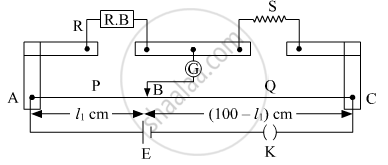
What is the end error in a meter bridge? How is it overcome? The resistances in the two arms of the metre bridge are R = Ω and S respectively. When the resistance S is shunted with equal resistance, the new balance length found to be 1.5 l1, where l2 is the initial balancing length. calculate the value of s.
If n cells each of emf e and internal resistance r are connected in parallel, then the total emf and internal resistance will be ______.
A block of metal is heated directly by dissipating power in the internal resistance of block. Because of temperature rise, the resistance increases exponentially with time and is given by R(t) = 0.5 e2t, where t is in second. The block is connected across a 110 V source and dissipates 7644 J heat energy over a certain period of time. This period of time is ______ × 10-1 sec (take ln 0.367 = -1).
What is the unit of EMF of a cell?
The relationship between terminal potential difference (V), EMF (ε), current (I), and internal resistance (r) is given by:
When a cell is short-circuited (R = 0), the maximum current that can flow is:
During charging, electrical energy is converted to:
