Advertisements
Advertisements
प्रश्न
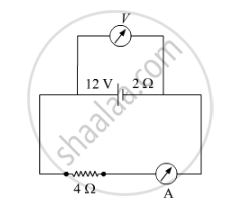
A battery of emf 12 V and internal resistance 2 Ω is connected to a 4 Ω resistor as shown in the figure.
(a) Show that a voltmeter when placed across the cell and across the resistor, in turn, gives the same reading.
(b) To record the voltage and the current in the circuit, why is voltmeter placed in parallel and ammeter in series in the circuit?
Advertisements
उत्तर
(i) According to the definition of terminal potential difference,
E = V + Ir
`=>V=E-Ir`
E = 12 V, r = 2 Ω
V = 12 – 2I
When the voltmeter is connected across the cell.
`I=12/(4+2)=2A`
V1 = 12 – 2 (2) = 8 V
When the voltmeter is connected across the resistor.
V2 = IR
= 2 × 4 = 8 V
V1 = V2
Hence, from the above relation we can see that when voltmeter placed across the cell and across the resistor, gives the same reading
(ii) Voltmeter has very high resistance to ensure that it's connection does not alter the flow of current in the circuit. We connect it in parallel and we also know that current chooses only the low resistance path. Hence, it is connected in parallel to the load across which potential difference is to be measured.
Ammeter measures value of current flowing through the circuit so it should be connected in the series. Ammeter has very low resistance to ensure that all the current flows through it. Thus, it gives a correct reading of the current when connected in series.
APPEARS IN
संबंधित प्रश्न
Distinguish between emf and terminal voltage of a cell.
A storage battery of emf 8.0 V and internal resistance 0.5 Ω is being charged by a 120 V dc supply using a series resistor of 15.5 Ω. What is the terminal voltage of the battery during charging? What is the purpose of having a series resistor in the charging circuit?
A cell of emf ‘E’ and internal resistance ‘r’ draws a current ‘I’. Write the relation between terminal voltage ‘V’ in terms of E, I and r ?
Two non-ideal batteries are connected in parallel. Consider the following statements:-
(A) The equivalent emf is smaller than either of the two emfs.
(B) The equivalent internal resistance is smaller than either of the two internal resistances.
Five cells each of emf E and internal resistance r send the same amount of current through an external resistance R whether the cells are connected in parallel or in series. Then the ratio `("R"/"r")` is:
An electric cell is a device that converts which form of energy into electrical energy?
When current is drawn from or supplied to a cell, the potential difference across its terminals is called:
During discharging of a cell, the current direction flows out of:
During charging of a cell, the terminal potential difference formula is:
