Advertisements
Advertisements
Question
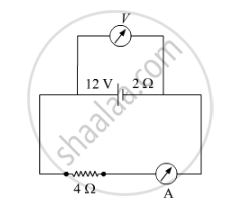
A battery of emf 12 V and internal resistance 2 Ω is connected to a 4 Ω resistor as shown in the figure.
(a) Show that a voltmeter when placed across the cell and across the resistor, in turn, gives the same reading.
(b) To record the voltage and the current in the circuit, why is voltmeter placed in parallel and ammeter in series in the circuit?
Advertisements
Solution
(i) According to the definition of terminal potential difference,
E = V + Ir
`=>V=E-Ir`
E = 12 V, r = 2 Ω
V = 12 – 2I
When the voltmeter is connected across the cell.
`I=12/(4+2)=2A`
V1 = 12 – 2 (2) = 8 V
When the voltmeter is connected across the resistor.
V2 = IR
= 2 × 4 = 8 V
V1 = V2
Hence, from the above relation we can see that when voltmeter placed across the cell and across the resistor, gives the same reading
(ii) Voltmeter has very high resistance to ensure that it's connection does not alter the flow of current in the circuit. We connect it in parallel and we also know that current chooses only the low resistance path. Hence, it is connected in parallel to the load across which potential difference is to be measured.
Ammeter measures value of current flowing through the circuit so it should be connected in the series. Ammeter has very low resistance to ensure that all the current flows through it. Thus, it gives a correct reading of the current when connected in series.
APPEARS IN
RELATED QUESTIONS
Distinguish between emf and terminal voltage of a cell.
A cell of emf 'E' and internal resistance 'r' is connected across a variable resistor 'R'. Plot a graph showing variation of terminal voltage 'V' of the cell versus the current 'I'. Using the plot, show how the emf of the cell and its internal resistance can be determined.
In a potentiometer arrangement, a cell of emf 1.25 V gives a balance point at 35.0 cm length of the wire. If the cell is replaced by another cell and the balance point shifts to 63.0 cm, what is the emf of the second cell?
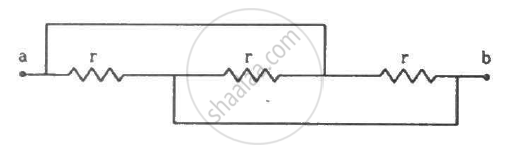
Find the equivalent resistance of the network shown in the figure between the points a and b.
The temperatures of the junctions of a bismuth-silver thermocouple are maintained at 0°C and 0.001°C. Find the thermo-emf (Seebeck emf) developed. For bismuth-silver, a = − 46 × 10−6 V°C−1 and b = −0.48 × 10⁻⁶ V°C−2.
Answer the following question.
A cell of emf E and internal resistance r is connected across a variable resistor R. Plot the shape of graphs showing a variation of terminal voltage V with (i) R and (ii) circuit current I.
If n cells each of emf e and internal resistance r are connected in parallel, then the total emf and internal resistance will be ______.
An ac generator generates an emf which is given by e = 311 sin (240 πt) V. Calculate:
- frequency of the emf.
- r.m.s. value of the emf.
Internal resistance of a cell is the resistance offered by which component?
During discharging of a cell, the current direction flows out of:
