Advertisements
Advertisements
प्रश्न
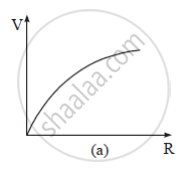
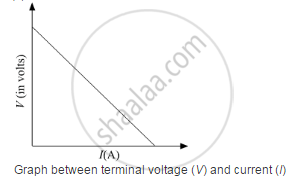
A cell of emf 'E' and internal resistance 'r' is connected across a variable load resistor R. Draw the plots of the terminal voltage V versus (i) R and (ii) the current I.
It is found that when R = 4 Ω, the current is 1 A and when R is increased to 9 Ω, the current reduces to 0.5 A. Find the values of the emf E and internal resistance r.
Advertisements
उत्तर
(i)
Plot for V vs. R
(ii)
When R = 4 Ω and I = 1 A
We know
Terminal voltage, V = E − Ir
So, we have
V = IR = 4 = E − Ir
or
E − r = 4 ..... (i)
When R' = 9 Ω and I' = 0.5 A
V = IR = 0.5 × 9 = E − 0.5r
or
E − 0.5r = 4.5 ..... (ii)
Solving (i) and (ii), we get
r = 1 Ω and E = 5 V
APPEARS IN
संबंधित प्रश्न
Distinguish between emf and terminal voltage of a cell.
Two identical cells, each of emf E, having negligible internal resistance, are connected in parallel with each other across an external resistance R. What is the current through this resistance?
Can the potential difference across a battery be greater than its emf?
A battery of emf 100 V and a resistor of resistance 10 kΩ are joined in series. This system is used as a source to supply current to an external resistance R. If R is not greater than 100 Ω, the current through it is constant up to two significant digits.
Find its value. This is the basic principle of a constant-current source.
Answer the following question.
A cell of emf E and internal resistance r is connected across a variable resistor R. Plot the shape of graphs showing a variation of terminal voltage V with (i) R and (ii) circuit current I.
A block of metal is heated directly by dissipating power in the internal resistance of block. Because of temperature rise, the resistance increases exponentially with time and is given by R(t) = 0.5 e2t, where t is in second. The block is connected across a 110 V source and dissipates 7644 J heat energy over a certain period of time. This period of time is ______ × 10-1 sec (take ln 0.367 = -1).
An ac generator generates an emf which is given by e = 311 sin (240 πt) V. Calculate:
- frequency of the emf.
- r.m.s. value of the emf.
A wire of length ‘l’ and resistance 100 Ω is divided into 10 equal parts. The first 5 parts are connected in series while the next 5 parts are connected in parallel. The two combinations are again connected in series. The resistance of this final combination is ______.
During discharging of a cell, the current direction flows out of:
During charging of a cell, the terminal potential difference formula is:
