Advertisements
Advertisements
प्रश्न
Two capacitors of unknown capacitances C1 and C2 are connected first in series and then in parallel across a battery of 100 V. If the energy stored in the two combinations is 0.045 J and 0.25 J respectively, determine the value of C1 and C2. Also calculate the charge on each capacitor in parallel combination.
Advertisements
उत्तर
When the capacitors are connected in parallel,
Equivalent capacitance, CP=C1+C2
The energy stored in the combination of the capacitors, `E_P=1/2C_pV^2`
`=>E_P=1/2(C_1+C_2)(100^2)=0.25J`
⇒(C1+C2)=5×10⁻⁵ .....(i)
When the capacitors are connected in series,
Equivalent capacitance, `C_S=(C_1C_2)/(C_1+C_2)`
The energy stored in the combination of the capacitors,
`E_S=1/2C_SV^2`
`=>E_S=1/2(C_1C_2)/(C_1+C_2)(100)^2=0.045J`
`1/2(C_1C_2)/(5xx10^(-5))(100)^2=0.045J`
⇒C1C2=0.045×10−4×5×10−5×2=4.5×10⁻¹⁰
(C1−C2)2=(C1+C2)2−4C1C2
⇒(C1−C2)2=25×10−10−4×4.5×10−10=7×10⁻¹⁰
`=>(C_1-C_2)=sqrt(7xx10^(-10))=2.64xx10^(-5)`
C1−C2=2.64×10⁻⁵ .....(ii)
Solving (i) and (ii), we get
C1 = 35 μF and C2 = 15 μF
When the capacitors are connected in parallel, the charge on each of them can be obtained as follows:
Q1=C1V=35×10−6×100=35×10−4 C
Q2=C2V=15×10−6×100=15×10−4 C
APPEARS IN
संबंधित प्रश्न
Deduce an expression for equivalent capacitance C when three capacitors C1, C2 and C3 connected in parallel.
Suppose a charge +Q1 is given to the positive plate and a charge −Q2 to the negative plate of a capacitor. What is the "charge on the capacitor"?
If the capacitors in the previous question are joined in parallel, the capacitance and the breakdown voltage of the combination will be
The following figure shows two capacitors connected in series and joined to a battery. The graph shows the variation in potential as one moves from left to right on the branch containing the capacitors.
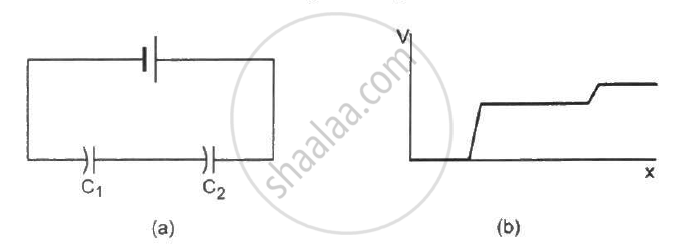
A capacitor of capacitance 5⋅00 µF is charged to 24⋅0 V and another capacitor of capacitance 6⋅0 µF is charged to 12⋅0 V. (a) Find the energy stored in each capacitor. (b) The positive plate of the first capacitor is now connected to the negative plate of the second and vice versa. Find the new charges on the capacitors. (c) Find the loss of electrostatic energy during the process. (d) Where does this energy go?
Three capacitors of capacitance `C_1 = 3muf` , `C_2 = 6muf` , `C_3 = 10muf` , are connected to a 10V battery as shown in figure 3 below :
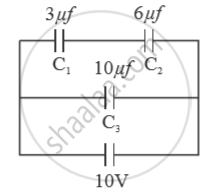
Calculate :
(a) Equivalent capacitance.
(b) Electrostatic potential energy stored in the system
Which quantity describes a single capacitor that stores the same charge at the same voltage as an entire combination?
Which formula gives the equivalent capacitance of capacitors in series?
For two capacitors in series, which expression gives the voltage across the first capacitor?
Which expressions give the energy stored in series and parallel combinations, respectively?
