Advertisements
Advertisements
प्रश्न
Two capacitors of unknown capacitances C1 and C2 are connected first in series and then in parallel across a battery of 100 V. If the energy stored in the two combinations is 0.045 J and 0.25 J respectively, determine the value of C1 and C2. Also calculate the charge on each capacitor in parallel combination.
Advertisements
उत्तर
When the capacitors are connected in parallel,
Equivalent capacitance, CP=C1+C2
The energy stored in the combination of the capacitors, `E_P=1/2C_pV^2`
`=>E_P=1/2(C_1+C_2)(100^2)=0.25J`
⇒(C1+C2)=5×10⁻⁵ .....(i)
When the capacitors are connected in series,
Equivalent capacitance, `C_S=(C_1C_2)/(C_1+C_2)`
The energy stored in the combination of the capacitors,
`E_S=1/2C_SV^2`
`=>E_S=1/2(C_1C_2)/(C_1+C_2)(100)^2=0.045J`
`1/2(C_1C_2)/(5xx10^(-5))(100)^2=0.045J`
⇒C1C2=0.045×10−4×5×10−5×2=4.5×10⁻¹⁰
(C1−C2)2=(C1+C2)2−4C1C2
⇒(C1−C2)2=25×10−10−4×4.5×10−10=7×10⁻¹⁰
`=>(C_1-C_2)=sqrt(7xx10^(-10))=2.64xx10^(-5)`
C1−C2=2.64×10⁻⁵ .....(ii)
Solving (i) and (ii), we get
C1 = 35 μF and C2 = 15 μF
When the capacitors are connected in parallel, the charge on each of them can be obtained as follows:
Q1=C1V=35×10−6×100=35×10−4 C
Q2=C2V=15×10−6×100=15×10−4 C
APPEARS IN
संबंधित प्रश्न
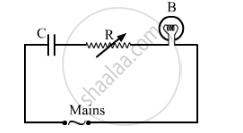
A capacitor 'C', a variable resistor 'R' and a bulb 'B' are connected in series to the ac mains in circuit as shown. The bulb glows with some brightness. How will the glow of the bulb change if (i) a dielectric slab is introduced between the plates of the capacitor, keeping resistance R to be the same; (ii) the resistance R is increased keeping the same capacitance?
A cylindrical capacitor has two co-axial cylinders of length 15 cm and radii 1.5 cm and 1.4 cm. The outer cylinder is earthed and the inner cylinder is given a charge of 3.5 µC. Determine the capacitance of the system and the potential of the inner cylinder. Neglect end effects (i.e., bending of field lines at the ends).
A parallel-plate capacitor has plates of unequal area. The larger plate is connected to the positive terminal of the battery and the smaller plate to its negative terminal. Let Q, and Q be the charges appearing on the positive and negative plates respectively.
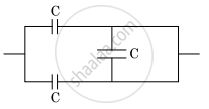
The equivalent capacitance of the combination shown in the figure is ______.
What is the charge relationship for capacitors in series?
Compared with the individual capacitors in a series combination, how large is the equivalent capacitance?
How is the total charge related to the charges on capacitors in parallel?
Which relation gives the charge on one capacitor in a parallel combination when the common voltage is \[V\]?
A charge of \[1.6\times10^{-11}\,\mathrm{C}\] produces a potential difference of \[10\,\mathrm{V}\]. What capacitance follows from \[C=\frac{Q}{V}\]?
Two capacitors with capacitances \[4\,\mu\mathrm{F}\] and \[4\,\mu\mathrm{F}\] are connected in parallel. What is their equivalent capacitance?
