Advertisements
Advertisements
प्रश्न
An ac circuit consists of a series combination of circuit elements X and Y. The current is ahead of the voltage in phase by `pi/4`. If element X is a pure resistor of 100 Ω,
(a) name the circuit element Y.
(b) calculate the rms value of current, if rms of voltage is 141 V.
(c) what will happen if the ac source is replaced by a dc source
Advertisements
उत्तर
(a) We have,
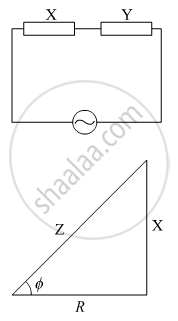
Φ = π/4
tan Φ = 1
`tanphi = "Reactance"/"Resistance"`
Reactance = Resistance
Y = 100 Ω
As, ϕ > 0°, means voltage ahead of current Hence element Y is an Inductor.
(b)
`"R.m.s value of current" = "R.m.s value of voltage"/"Impedance"`
`"i"_"Rms" = 141/sqrt((100)^2+ (100)^2)`
`"i"_"Rms" = 141/(100sqrt2) = 141/(100 xx 1.41)`
iRms = 1 A
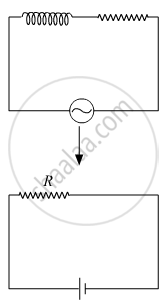
(c) If the Ac is Replace by DC, then the Inductor will behave as a short circuit, and the circuit will be purely Resistive.
APPEARS IN
संबंधित प्रश्न
Suppose a charge +Q1 is given to the positive plate and a charge −Q2 to the negative plate of a capacitor. What is the "charge on the capacitor"?
The plates of a parallel-plate capacitor are given equal positive charges. What will be the potential difference between the plates? What will be the charges on the facing surfaces and on the outer surfaces?
The separation between the plates of a charged parallel-plate capacitor is increased. Which of the following quantities will change?
(a) Charge on the capacitor
(b) Potential difference across the capacitor
(c) Energy of the capacitor
(d) Energy density between the plates
Three different capacitors are·connected in series. Then:-
In the circuit shown in figure, initially K1 is closed and K2 is open. What are the charges on each capacitors.
Then K1 was opened and K2 was closed (order is important), What will be the charge on each capacitor now? [C = 1µF]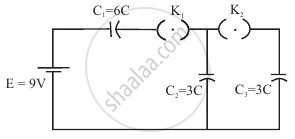
Two equal capacitors are first connected in series and then in parallel The ratio of the equivalent capacities in the two cases will be ______.
The potential difference that must be applied across the series and parallel combination of 4 identical capacitors such that the energy stored in them becomes the same. The ratio of potential difference in series to parallel combination is ______.
What is the voltage relationship for capacitors in parallel?
A charge of \[1.6\times10^{-11}\,\mathrm{C}\] produces a potential difference of \[10\,\mathrm{V}\]. What capacitance follows from \[C=\frac{Q}{V}\]?
