Advertisements
Advertisements
प्रश्न
A circuit is set up by connecting inductance L = 100 mH, resistor R = 100 Ω and a capacitor of reactance 200 Ω in series. An alternating emf of \[150\sqrt{2}\] V, 500/π Hz is applies across this series combination. Calculate the power dissipated in the resistor.
Advertisements
उत्तर
Given the r.m.s value of emf in the circuit Ev = 150√2 V
The impedance of the LCR- circuit is given by
\[Z = \sqrt{R^2 + \left( X_L - X_C \right)^2}\]
\[ = \sqrt{R^2 + \left( 2\pi fL - 200 \right)^2}\]
\[ = \sqrt{{100}^2 + \left( 2\pi \times \frac{500}{\pi} \times 0 . 1 - 200 \right)^2}\]
\[ = 100\sqrt{2} \Omega\]
The r.m.s value of current Iv in the circuit is given by
\[I_v = \frac{E_v}{Z} = \frac{150\sqrt{2}}{100\sqrt{2}} = 1 . 5 A\]
Power dissipated in the resistor = EvIv = 318.2 W
APPEARS IN
संबंधित प्रश्न
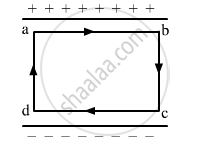
The electric field inside a parallel plate capacitor is E. Find the amount of work done in moving a charge q over a closed loop a b c d a.
An electrical technician requires a capacitance of 2 µF in a circuit across a potential difference of 1 kV. A large number of 1 µF capacitors are available to him each of which can withstand a potential difference of not more than 400 V. Suggest a possible arrangement that requires the minimum number of capacitors.
Figure 4 below shows a capacitor C, an inductor L and a resistor R, connected in series
to an a.c. supply of 220 V
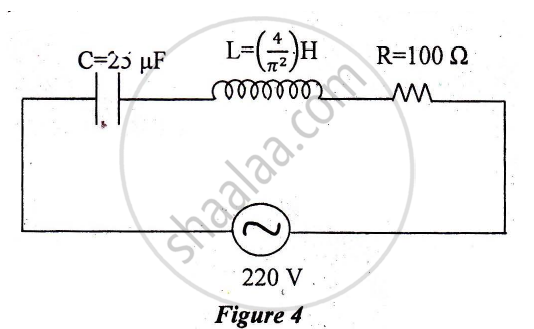
Calculate:
1) The resonant frequency of the given CLR circuit.
2) Current flowing through·the circuit.
3) Average power consumed by the circuit.
Suppose a charge +Q1 is given to the positive plate and a charge −Q2 to the negative plate of a capacitor. What is the "charge on the capacitor"?
A parallel-plate capacitor is connected to a battery. A metal sheet of negligible thickness is placed between the plates. The sheet remains parallel to the plates of the capacitor.
Three different capacitors are·connected in series. Then:-
Three capacitors of capacitances 2 pF, 3 pF and 4 pF are connected in parallel. What is the total capacitance of the combination?
What is the process of replacing a group of capacitors with a single equivalent capacitor that produces the same electrical effect called?
For two capacitors in series, which expression gives the voltage across the second capacitor?
How is the total charge related to the charges on capacitors in parallel?
