Advertisements
Advertisements
प्रश्न
The plates of a capacitor are 2⋅00 cm apart. An electron-proton pair is released somewhere in the gap between the plates and it is found that the proton reaches the negative plate at the same time as the electron reaches the positive plate. At what distance from the negative plate was the pair released?
Advertisements
उत्तर
Let the electric field inside the capacitor be E.
Now ,
Magnitude of acceleration of the electron, `a_e = (q_eE)/m_e`
Magnitude of acceleration of the proton, `a_p = (q_pE)/m_p`
Let t be the time taken by the electron and proton to reach the positive and negative plates, respectively.
The initial velocities of the proton and electron are zero.
Thus, the distance travelled by the proton is given by
`x = 1/2 (q_pE)/(m_p)t^2` .....(1)
And, the distance travelled by the electron is given by
`2-x = 1/2 (q_eE)/(m_e)t^2` ......(2)
On dividing (1) by (2), we get
`x/(2-x) = ((qpE)/(mp))/((qeE)/(m_e))` = `m_e/m_p` = `(9.1 xx 10^-31)/(1.67 xx 10^-27)` = `5.449 xx 10^-4`
⇒ `x = 10.898 xx 10^-4 - 5.449 xx 10^-4 x`
⇒ `x = (10.898 xx 10^-4)/1.0005449 = 1.08 xx 10^-8 "cm"`
APPEARS IN
संबंधित प्रश्न
Two capacitors of unknown capacitances C1 and C2 are connected first in series and then in parallel across a battery of 100 V. If the energy stored in the two combinations is 0.045 J and 0.25 J respectively, determine the value of C1 and C2. Also calculate the charge on each capacitor in parallel combination.
Three capacitors of capacitances 2 pF, 3 pF and 4 pF are connected in parallel. Determine the charge on each capacitor if the combination is connected to a 100 V supply.
A cylindrical capacitor has two co-axial cylinders of length 15 cm and radii 1.5 cm and 1.4 cm. The outer cylinder is earthed and the inner cylinder is given a charge of 3.5 µC. Determine the capacitance of the system and the potential of the inner cylinder. Neglect end effects (i.e., bending of field lines at the ends).
If the capacitors in the previous question are joined in parallel, the capacitance and the breakdown voltage of the combination will be
A parallel-plate capacitor having plate area 25 cm2 and separation 1⋅00 mm is connected to a battery of 6⋅0 V. Calculate the charge flown through the battery. How much work has been done by the battery during the process?
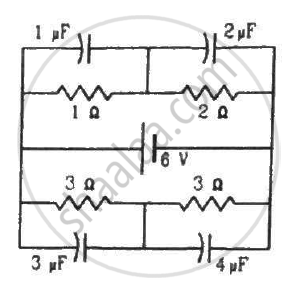
Find the charges on the four capacitors of capacitances 1 μF, 2 μF, 3 μF and 4 μF shown in the figure.
Three capacitors of capacitance `C_1 = 3muf` , `C_2 = 6muf` , `C_3 = 10muf` , are connected to a 10V battery as shown in figure 3 below :
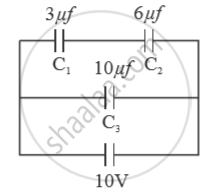
Calculate :
(a) Equivalent capacitance.
(b) Electrostatic potential energy stored in the system
Two parallel plate capacitors X and Y, have the same area of plates and same separation between plates. X has air and Y with dielectric of constant 2, between its plates. They are connected in series to a battery of 12 V. The ratio of electrostatic energy stored in X and Y is ______.
Capacitors connected in series have ______
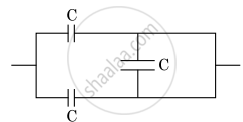
The equivalent capacitance of the combination shown in the figure is ______.
In the circuit shown in figure, initially K1 is closed and K2 is open. What are the charges on each capacitors.
Then K1 was opened and K2 was closed (order is important), What will be the charge on each capacitor now? [C = 1µF]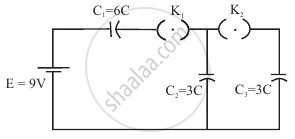
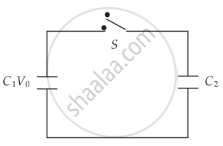
A capacitor of capacity C1 is charged to the potential of V0. On disconnecting with the battery, it is connected with an uncharged capacitor of capacity C2 as shown in the adjoining figure. Find the ratio of energies before and after the connection of switch S.
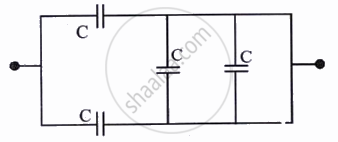
The equivalent capacitance of the combination shown is:
What is the charge relationship for capacitors in series?
Compared with the individual capacitors in a series combination, how large is the equivalent capacitance?
What is the equivalent capacitance of \[n\] identical capacitors, each with capacitance \[C\], connected in series?
For two capacitors in series, which expression gives the voltage across the first capacitor?
In a series combination, which capacitor has the larger voltage drop?
Compared with the individual capacitors in a parallel combination, how large is the equivalent capacitance?
Which formula gives the equivalent capacitance of capacitors in parallel?
