Advertisements
Advertisements
प्रश्न
Three capacitors of capacitances 2 pF, 3 pF and 4 pF are connected in parallel. What is the total capacitance of the combination?
Advertisements
उत्तर
Capacitances of the given capacitors are
C1 = 2 pF
C2 = 3 pF
C3 = 4 pF
For capacitors connected in parallel, the equivalent capacitance is:
Ceq = 2 + 3 + 4
Ceq = 9 pF
Therefore, the total capacitance of the combination is 9 pF.
संबंधित प्रश्न
Figure 4 below shows a capacitor C, an inductor L and a resistor R, connected in series
to an a.c. supply of 220 V
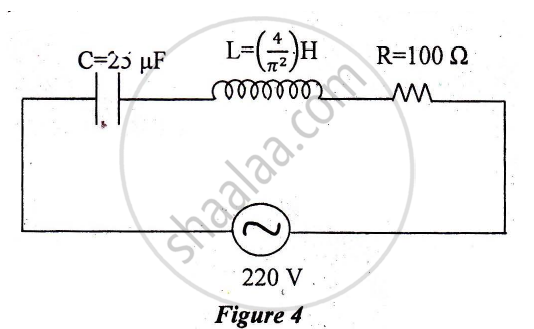
Calculate:
1) The resonant frequency of the given CLR circuit.
2) Current flowing through·the circuit.
3) Average power consumed by the circuit.
If the capacitors in the previous question are joined in parallel, the capacitance and the breakdown voltage of the combination will be
A parallel-plate capacitor has plates of unequal area. The larger plate is connected to the positive terminal of the battery and the smaller plate to its negative terminal. Let Q, and Q be the charges appearing on the positive and negative plates respectively.
The separation between the plates of a charged parallel-plate capacitor is increased. Which of the following quantities will change?
(a) Charge on the capacitor
(b) Potential difference across the capacitor
(c) Energy of the capacitor
(d) Energy density between the plates
A parallel-plate capacitor having plate area 25 cm2 and separation 1⋅00 mm is connected to a battery of 6⋅0 V. Calculate the charge flown through the battery. How much work has been done by the battery during the process?
Three capacitors of capacitance `C_1 = 3muf` , `C_2 = 6muf` , `C_3 = 10muf` , are connected to a 10V battery as shown in figure 3 below :
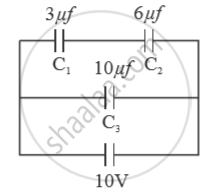
Calculate :
(a) Equivalent capacitance.
(b) Electrostatic potential energy stored in the system
An ac circuit consists of a series combination of circuit elements X and Y. The current is ahead of the voltage in phase by `pi /4` . If element X is a pure resistor of 100Ω ,
(a) name the circuit element Y.
(b) calculate the rms value of current, if rms value of voltage is 141V.
(c) what will happen if the ac source is replaced by a dc source ?
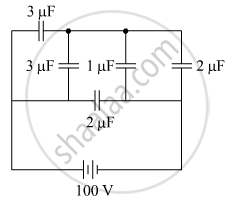
The figure shows a network of five capacitors connected to a 100 V supply. Calculate the total energy stored in the network.
Three different capacitors are·connected in series. Then:-
Capacitors connected in series have ______
In the circuit shown in figure, initially K1 is closed and K2 is open. What are the charges on each capacitors.
Then K1 was opened and K2 was closed (order is important), What will be the charge on each capacitor now? [C = 1µF]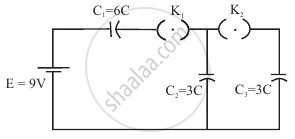
Two charges q1 and q2 are placed at (0, 0, d) and (0, 0, – d) respectively. Find locus of points where the potential a zero.
Two equal capacitors are first connected in series and then in parallel The ratio of the equivalent capacities in the two cases will be ______.
Which formula gives the equivalent capacitance of capacitors in series?
What is the equivalent capacitance of \[n\] identical capacitors, each with capacitance \[C\], connected in series?
How is the total charge related to the charges on capacitors in parallel?
Which relation gives the charge on one capacitor in a parallel combination when the common voltage is \[V\]?
A charge of \[1.6\times10^{-11}\,\mathrm{C}\] produces a potential difference of \[10\,\mathrm{V}\]. What capacitance follows from \[C=\frac{Q}{V}\]?
