Advertisements
Advertisements
प्रश्न
A parallel-plate capacitor is connected to a battery. A metal sheet of negligible thickness is placed between the plates. The sheet remains parallel to the plates of the capacitor.
विकल्प
The battery will supply more charge.
The capacitance will increase.
The potential difference between the plates will increase.
Equal and opposite charges will appear on the two faces of the metal plate.
Advertisements
उत्तर
Equal and opposite charges will appear on the two faces of the metal plate.
The capacitance of the capacitor in which a dielectric slab of dielectric constant K, area A and thickness t is inserted between the plates of the capacitor of area A and separated by a distance d is given by `C = (∈_0A)/((d-t)+(t/K))`
Since it is given that the thickness of the sheet is negligible, the above formula reduces to C = `(∈_0A)/d`. In other words, there will not be any change in the electric field, potential or charge.
Only, equal and opposite charges will appear on the two faces of the metal plate because of induction due to the presence of the charges on the plates of the capacitor.
APPEARS IN
संबंधित प्रश्न
A cylindrical capacitor has two co-axial cylinders of length 15 cm and radii 1.5 cm and 1.4 cm. The outer cylinder is earthed and the inner cylinder is given a charge of 3.5 µC. Determine the capacitance of the system and the potential of the inner cylinder. Neglect end effects (i.e., bending of field lines at the ends).
Figure 4 below shows a capacitor C, an inductor L and a resistor R, connected in series
to an a.c. supply of 220 V
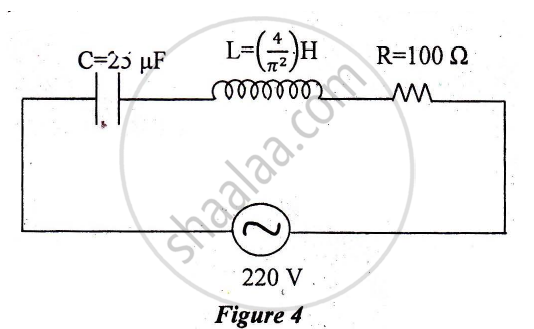
Calculate:
1) The resonant frequency of the given CLR circuit.
2) Current flowing through·the circuit.
3) Average power consumed by the circuit.
The plates of a capacitor are 2⋅00 cm apart. An electron-proton pair is released somewhere in the gap between the plates and it is found that the proton reaches the negative plate at the same time as the electron reaches the positive plate. At what distance from the negative plate was the pair released?
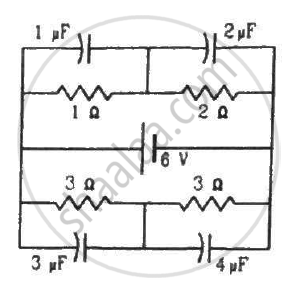
Find the charges on the four capacitors of capacitances 1 μF, 2 μF, 3 μF and 4 μF shown in the figure.
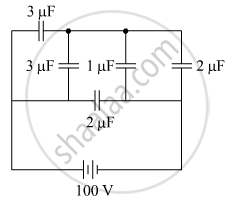
The figure shows a network of five capacitors connected to a 100 V supply. Calculate the total energy stored in the network.
An ac circuit consists of a series combination of circuit elements X and Y. The current is ahead of the voltage in phase by `pi/4`. If element X is a pure resistor of 100 Ω,
(a) name the circuit element Y.
(b) calculate the rms value of current, if rms of voltage is 141 V.
(c) what will happen if the ac source is replaced by a dc source
Two parallel plate capacitors X and Y, have the same area of plates and same separation between plates. X has air and Y with dielectric of constant 2, between its plates. They are connected in series to a battery of 12 V. The ratio of electrostatic energy stored in X and Y is ______.
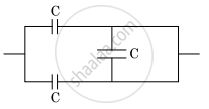
The equivalent capacitance of the combination shown in the figure is ______.
What is the process of replacing a group of capacitors with a single equivalent capacitor that produces the same electrical effect called?
What is the charge relationship for capacitors in series?
How is the total voltage related to the voltages across capacitors in series?
What is the equivalent capacitance of \[n\] identical capacitors, each with capacitance \[C\], connected in series?
For two capacitors in series, which expression gives the voltage across the first capacitor?
In a series combination, which capacitor has the larger voltage drop?
What is the voltage relationship for capacitors in parallel?
How is the total charge related to the charges on capacitors in parallel?
Which formula gives the equivalent capacitance of capacitors in parallel?
Which relation gives the charge on one capacitor in a parallel combination when the common voltage is \[V\]?
Two capacitors with capacitances \[4\,\mu\mathrm{F}\] and \[4\,\mu\mathrm{F}\] are connected in parallel. What is their equivalent capacitance?
