Advertisements
Advertisements
प्रश्न
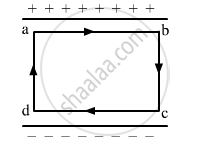
The electric field inside a parallel plate capacitor is E. Find the amount of work done in moving a charge q over a closed loop a b c d a.
Advertisements
उत्तर
Work done, W= F.d
Here, F is the force exerted on the charge (q) due to electric field (E) and is given by:
F=qE
Net displacement, d = 0
∴ W=0
APPEARS IN
संबंधित प्रश्न
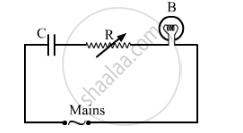
A capacitor 'C', a variable resistor 'R' and a bulb 'B' are connected in series to the ac mains in circuit as shown. The bulb glows with some brightness. How will the glow of the bulb change if (i) a dielectric slab is introduced between the plates of the capacitor, keeping resistance R to be the same; (ii) the resistance R is increased keeping the same capacitance?
A parallel-plate capacitor has plates of unequal area. The larger plate is connected to the positive terminal of the battery and the smaller plate to its negative terminal. Let Q, and Q be the charges appearing on the positive and negative plates respectively.
A parallel-plate capacitor having plate area 25 cm2 and separation 1⋅00 mm is connected to a battery of 6⋅0 V. Calculate the charge flown through the battery. How much work has been done by the battery during the process?
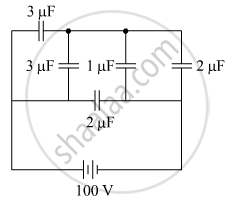
The figure shows a network of five capacitors connected to a 100 V supply. Calculate the total energy stored in the network.
Three capacitors each of 4 µF are to be connected in such a way that the effective capacitance is 6µF. This can be done by connecting them:
Capacitors connected in series have ______
Which quantity describes a single capacitor that stores the same charge at the same voltage as an entire combination?
What is the charge relationship for capacitors in series?
For two capacitors in series, which expression gives the voltage across the first capacitor?
Compared with the individual capacitors in a parallel combination, how large is the equivalent capacitance?
