Advertisements
Advertisements
प्रश्न
An ac circuit consists of a series combination of circuit elements X and Y. The current is ahead of the voltage in phase by `pi /4` . If element X is a pure resistor of 100Ω ,
(a) name the circuit element Y.
(b) calculate the rms value of current, if rms value of voltage is 141V.
(c) what will happen if the ac source is replaced by a dc source ?
Advertisements
उत्तर
(a) Since current is leading voltage by `pi/4`, current leak in capacitive curcuit as X is pure resistor therefore Y capacitor.
(b) `phi = tan ^(-1) ((X_c - X_L)/R) X_L = 0`
`pi/4 = tan^(-1)((X_c)/R)`
`(X_c)/R= tan pi/4`
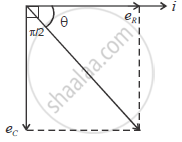
`(X_c)/R= 1` Xc = R
Xc = 100 Ω
`t = sqrt((100)^2 + (100)^2)`
`t = 100 sqrt(2) Omega = 100 xx 1.41 = 141 Omega `
`i_(RMS) = (e_(RMS))/z = 141/141 = 1A`
iRMS = 1A
(c) If we replace ac source by dc ω = 0
`X_c = 1/(omega _c)`
`X_c = 1/0 = ∞ Omega`
`i = e/z = 141/ ∞ `
i = 0
APPEARS IN
संबंधित प्रश्न
If the capacitors in the previous question are joined in parallel, the capacitance and the breakdown voltage of the combination will be
A parallel-plate capacitor has plates of unequal area. The larger plate is connected to the positive terminal of the battery and the smaller plate to its negative terminal. Let Q, and Q be the charges appearing on the positive and negative plates respectively.
The separation between the plates of a charged parallel-plate capacitor is increased. Which of the following quantities will change?
(a) Charge on the capacitor
(b) Potential difference across the capacitor
(c) Energy of the capacitor
(d) Energy density between the plates
Two equal capacitors are first connected in series and then in parallel The ratio of the equivalent capacities in the two cases will be ______.
The capacitors, each of 4 µF are to be connected in such a way that the effective capacitance of the combination is 6 µF. This can be achieved by connecting ______.
Three capacitors of capacitances 2 pF, 3 pF and 4 pF are connected in parallel. What is the total capacitance of the combination?
The equivalent capacitance of the combination shown is:
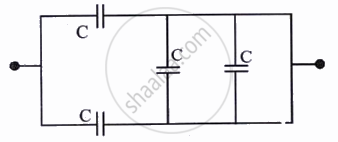
Which quantity describes a single capacitor that stores the same charge at the same voltage as an entire combination?
Which formula gives the equivalent capacitance of capacitors in parallel?
A charge of \[1.6\times10^{-11}\,\mathrm{C}\] produces a potential difference of \[10\,\mathrm{V}\]. What capacitance follows from \[C=\frac{Q}{V}\]?
