Advertisements
Advertisements
प्रश्न
An ac circuit consists of a series combination of circuit elements X and Y. The current is ahead of the voltage in phase by `pi /4` . If element X is a pure resistor of 100Ω ,
(a) name the circuit element Y.
(b) calculate the rms value of current, if rms value of voltage is 141V.
(c) what will happen if the ac source is replaced by a dc source ?
Advertisements
उत्तर
(a) Since current is leading voltage by `pi/4`, current leak in capacitive curcuit as X is pure resistor therefore Y capacitor.
(b) `phi = tan ^(-1) ((X_c - X_L)/R) X_L = 0`
`pi/4 = tan^(-1)((X_c)/R)`
`(X_c)/R= tan pi/4`
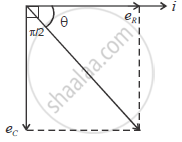
`(X_c)/R= 1` Xc = R
Xc = 100 Ω
`t = sqrt((100)^2 + (100)^2)`
`t = 100 sqrt(2) Omega = 100 xx 1.41 = 141 Omega `
`i_(RMS) = (e_(RMS))/z = 141/141 = 1A`
iRMS = 1A
(c) If we replace ac source by dc ω = 0
`X_c = 1/(omega _c)`
`X_c = 1/0 = ∞ Omega`
`i = e/z = 141/ ∞ `
i = 0
APPEARS IN
संबंधित प्रश्न
Three capacitors each of capacitance 9 pF are connected in series.
- What is the total capacitance of the combination?
- What is the potential difference across each capacitor if the combination is connected to a 120 V supply?
Each plate of a parallel plate capacitor has a charge q on it. The capacitor is now connected to a batter. Now,
(a) the facing surfaces of the capacitor have equal and opposite charges
(b) the two plates of the capacitor have equal and opposite charges
(c) the battery supplies equal and opposite charges to the two plates
(d) the outer surfaces of the plates have equal charges
A parallel-plate capacitor is connected to a battery. A metal sheet of negligible thickness is placed between the plates. The sheet remains parallel to the plates of the capacitor.
Three different capacitors are·connected in series. Then:-
In the circuit shown in figure, initially K1 is closed and K2 is open. What are the charges on each capacitors.
Then K1 was opened and K2 was closed (order is important), What will be the charge on each capacitor now? [C = 1µF]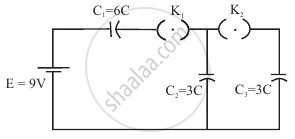
Two charges q1 and q2 are placed at (0, 0, d) and (0, 0, – d) respectively. Find locus of points where the potential a zero.
Which formula gives the equivalent capacitance of capacitors in series?
What is the equivalent capacitance of \[n\] identical capacitors, each with capacitance \[C\], connected in series?
Which relation gives the charge on one capacitor in a parallel combination when the common voltage is \[V\]?
