Advertisements
Advertisements
Question
An ac circuit consists of a series combination of circuit elements X and Y. The current is ahead of the voltage in phase by `pi /4` . If element X is a pure resistor of 100Ω ,
(a) name the circuit element Y.
(b) calculate the rms value of current, if rms value of voltage is 141V.
(c) what will happen if the ac source is replaced by a dc source ?
Advertisements
Solution
(a) Since current is leading voltage by `pi/4`, current leak in capacitive curcuit as X is pure resistor therefore Y capacitor.
(b) `phi = tan ^(-1) ((X_c - X_L)/R) X_L = 0`
`pi/4 = tan^(-1)((X_c)/R)`
`(X_c)/R= tan pi/4`
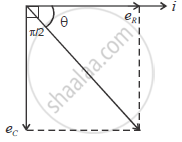
`(X_c)/R= 1` Xc = R
Xc = 100 Ω
`t = sqrt((100)^2 + (100)^2)`
`t = 100 sqrt(2) Omega = 100 xx 1.41 = 141 Omega `
`i_(RMS) = (e_(RMS))/z = 141/141 = 1A`
iRMS = 1A
(c) If we replace ac source by dc ω = 0
`X_c = 1/(omega _c)`
`X_c = 1/0 = ∞ Omega`
`i = e/z = 141/ ∞ `
i = 0
APPEARS IN
RELATED QUESTIONS
Three capacitors of capacitances 2 pF, 3 pF and 4 pF are connected in parallel. Determine the charge on each capacitor if the combination is connected to a 100 V supply.
A parallel-plate capacitor has plates of unequal area. The larger plate is connected to the positive terminal of the battery and the smaller plate to its negative terminal. Let Q, and Q be the charges appearing on the positive and negative plates respectively.
A parallel-plate capacitor is connected to a battery. A metal sheet of negligible thickness is placed between the plates. The sheet remains parallel to the plates of the capacitor.
Two parallel plate capacitors X and Y, have the same area of plates and same separation between plates. X has air and Y with dielectric of constant 2, between its plates. They are connected in series to a battery of 12 V. The ratio of electrostatic energy stored in X and Y is ______.
Two equal capacitors are first connected in series and then in parallel The ratio of the equivalent capacities in the two cases will be ______.
The potential difference that must be applied across the series and parallel combination of 4 identical capacitors such that the energy stored in them becomes the same. The ratio of potential difference in series to parallel combination is ______.
What is the process of replacing a group of capacitors with a single equivalent capacitor that produces the same electrical effect called?
Which formula gives the equivalent capacitance of capacitors in series?
Compared with the individual capacitors in a parallel combination, how large is the equivalent capacitance?
Which expressions give the energy stored in series and parallel combinations, respectively?
