Advertisements
Advertisements
Question
Deduce an expression for equivalent capacitance C when three capacitors C1, C2 and C3 connected in parallel.
Advertisements
Solution
An expression for effective capacitance in the parallel grouping of capacitors :
Consider three capacitors of capacitance C1 , C2 and C3 are connected in parallel.
Let Q1, Q2 and Q3 be the charges deposited on the capacitors as shown in the figure.
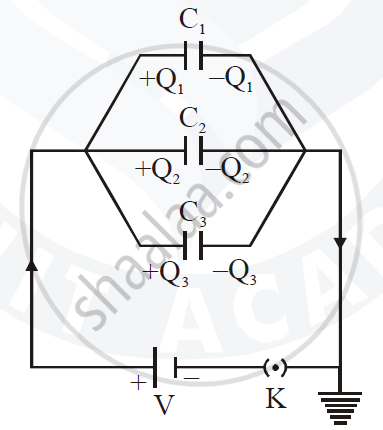
Suppose a potential difference ‘V ’ is applied across the combination. Then, the potential difference between the plates of each capacitor is V but charges on each capacitor are different. Since different current flows through different branches, so the charges are given by
`Q_1 = C_1V.Q_2 = C_2V. Q_3 = C_3V` ....(i)
From the principle of conservation of charge
`Q = Q_1 + Q_2 + Q_3`
`Q = C_1V + C_2V + C_3V` [From equation (i)]
`∴ Q = V(C_1 + C_2 + C_3)`
If these capacitors are replaced by a single capacitor of capacity CP such that `Q = C_PV` then using equation (ii) we have,
`C_PV = V(C_1+C_2+C_3)`
`C_P = C_1+C_2+C_3`
APPEARS IN
RELATED QUESTIONS
An electrical technician requires a capacitance of 2 µF in a circuit across a potential difference of 1 kV. A large number of 1 µF capacitors are available to him each of which can withstand a potential difference of not more than 400 V. Suggest a possible arrangement that requires the minimum number of capacitors.
A circuit is set up by connecting inductance L = 100 mH, resistor R = 100 Ω and a capacitor of reactance 200 Ω in series. An alternating emf of \[150\sqrt{2}\] V, 500/π Hz is applies across this series combination. Calculate the power dissipated in the resistor.
The separation between the plates of a charged parallel-plate capacitor is increased. Which of the following quantities will change?
(a) Charge on the capacitor
(b) Potential difference across the capacitor
(c) Energy of the capacitor
(d) Energy density between the plates
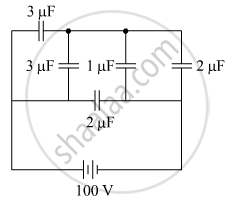
The figure shows a network of five capacitors connected to a 100 V supply. Calculate the total energy stored in the network.
An ac circuit consists of a series combination of circuit elements X and Y. The current is ahead of the voltage in phase by `pi/4`. If element X is a pure resistor of 100 Ω,
(a) name the circuit element Y.
(b) calculate the rms value of current, if rms of voltage is 141 V.
(c) what will happen if the ac source is replaced by a dc source
Capacitors connected in series have ______
The equivalent capacitance of the combination shown in the figure is ______.
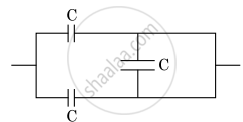
The equivalent capacitance of the combination shown is:
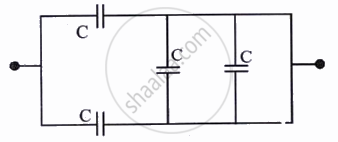
Compared with the individual capacitors in a series combination, how large is the equivalent capacitance?
Which expressions give the energy stored in series and parallel combinations, respectively?
