Advertisements
Advertisements
Question
Three capacitors of capacitances 2 pF, 3 pF and 4 pF are connected in parallel. Determine the charge on each capacitor if the combination is connected to a 100 V supply.
Advertisements
Solution
Given: Supply voltage, V = 100 V
In a parallel combination, the potential difference across each capacitor is the same.
V1 = V2 = V3 = 100 V
Charge on a capacitor of capacitance C and potential difference V is given by the relation,
q = CV
For C1 = 2 pF,
q1 = C1V1
= 2 × 100
= 200 pC
= 2 × 10⁻¹⁰ C
For C2 = 3 pF,
q2 = C2V2
= 3 × 100
= 300 pC
= 3 × 10⁻¹⁰ C
For C3 = 4 pF,
q3 = C3V3
= 4 × 100
= 400 pC
= 4 × 10⁻¹⁰ C
RELATED QUESTIONS
An electrical technician requires a capacitance of 2 µF in a circuit across a potential difference of 1 kV. A large number of 1 µF capacitors are available to him each of which can withstand a potential difference of not more than 400 V. Suggest a possible arrangement that requires the minimum number of capacitors.
Figure 4 below shows a capacitor C, an inductor L and a resistor R, connected in series
to an a.c. supply of 220 V
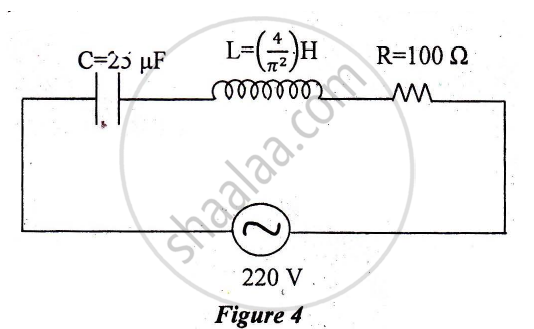
Calculate:
1) The resonant frequency of the given CLR circuit.
2) Current flowing through·the circuit.
3) Average power consumed by the circuit.
Suppose a charge +Q1 is given to the positive plate and a charge −Q2 to the negative plate of a capacitor. What is the "charge on the capacitor"?
A parallel-plate capacitor is connected to a battery. A metal sheet of negligible thickness is placed between the plates. The sheet remains parallel to the plates of the capacitor.
Three capacitors of capacitance `C_1 = 3muf` , `C_2 = 6muf` , `C_3 = 10muf` , are connected to a 10V battery as shown in figure 3 below :
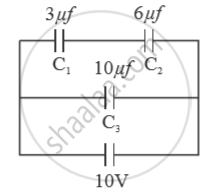
Calculate :
(a) Equivalent capacitance.
(b) Electrostatic potential energy stored in the system
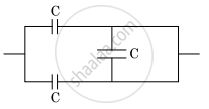
The equivalent capacitance of the combination shown in the figure is ______.
In the circuit shown in figure, initially K1 is closed and K2 is open. What are the charges on each capacitors.
Then K1 was opened and K2 was closed (order is important), What will be the charge on each capacitor now? [C = 1µF]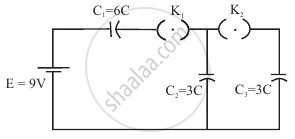
The capacitors, each of 4 µF are to be connected in such a way that the effective capacitance of the combination is 6 µF. This can be achieved by connecting ______.
The equivalent capacitance of the combination shown is:
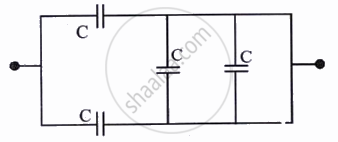
What is the process of replacing a group of capacitors with a single equivalent capacitor that produces the same electrical effect called?
How is the total voltage related to the voltages across capacitors in series?
Compared with the individual capacitors in a series combination, how large is the equivalent capacitance?
In a series combination, which capacitor has the larger voltage drop?
What is the voltage relationship for capacitors in parallel?
How is the total charge related to the charges on capacitors in parallel?
Two capacitors with capacitances \[4\,\mu\mathrm{F}\] and \[4\,\mu\mathrm{F}\] are connected in parallel. What is their equivalent capacitance?
