Advertisements
Advertisements
Question
A wire of resistance ‘R’ is cut into ‘n’ equal parts. These parts are then connected in parallel with each other. The equivalent resistance of the combination is:
Options
nR
R/n
n/R2
R/n2
Advertisements
Solution
A wire of resistance ‘R’ is cut into ‘n’ equal parts. These parts are then connected in parallel with each other. The equivalent resistance of the combination is R/n2.
APPEARS IN
RELATED QUESTIONS
A cylindrical capacitor has two co-axial cylinders of length 15 cm and radii 1.5 cm and 1.4 cm. The outer cylinder is earthed and the inner cylinder is given a charge of 3.5 µC. Determine the capacitance of the system and the potential of the inner cylinder. Neglect end effects (i.e., bending of field lines at the ends).
Deduce an expression for equivalent capacitance C when three capacitors C1, C2 and C3 connected in parallel.
Suppose a charge +Q1 is given to the positive plate and a charge −Q2 to the negative plate of a capacitor. What is the "charge on the capacitor"?
Three capacitors each of 4 µF are to be connected in such a way that the effective capacitance is 6µF. This can be done by connecting them:
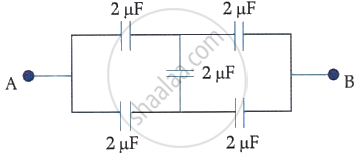
In the following circuit, the equivalent capacitance between terminal A and terminal B is:
What is the process of replacing a group of capacitors with a single equivalent capacitor that produces the same electrical effect called?
What is the work done per unit charge in moving a charge from one plate of a capacitor to the other called?
Which formula gives the equivalent capacitance of capacitors in series?
For two capacitors in series, which expression gives the voltage across the first capacitor?
Which formula gives the equivalent capacitance of capacitors in parallel?
