Advertisements
Advertisements
Question
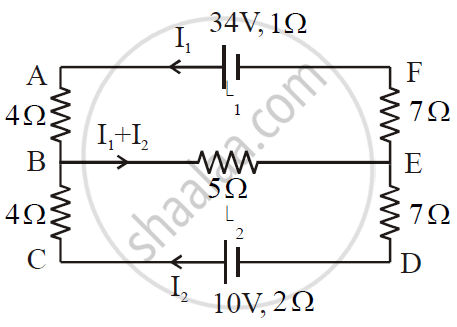
ε1 and ε2 are two batteries having emf of 34V and 10V respectively and internal resistance of 1Ω and 2Ω respectively. They are connected as shown in the figure below. Using Kirchhoff’s Laws of electrical networks, calculate the currents I1 and I2.
Advertisements
Solution
By Kirchoff’s law of electrical networks consider closed loop ABEFA
`:. -4I_1 - 5(I_2 + I_2 ) - 7I_1 - I_1 + 34= 0`
`:. -4I_1 - 5I_1 - 5I_2 - 7I_1 - I_1 = -34`
`:. -17I_1 - 5I_2 = -34`
`:. 17I_1 + 5I_2 = 34` .....(1)
Consider closed loop BCDEB,
`4I_2 - 10 + 2I_2 + 7I_2 + 5(I_1 + I_2) = 0`
`:. 4I_2 + 2I_2 + 7I_2 + 5I_1 + 5I_2 = 10`
`18I_2 + 5I_1 = 10` ....(2)
Mutiply equation (1) by 5 and equation (2) by 17 and Substract

∴ `I_1 = 2A`
APPEARS IN
RELATED QUESTIONS
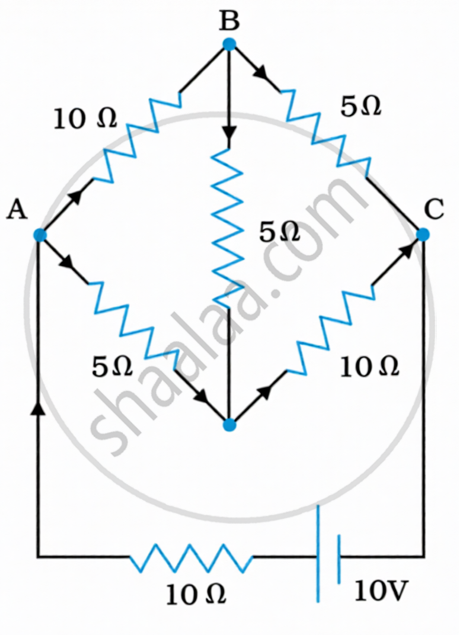
Determine the current in each branch of the network shown in figure.
Given the resistances of 1 Ω, 2 Ω, 3 Ω, how will be combine them to get an equivalent resistance of 6 Ω?
A capacitor of capacitance 8.0 μF is connected to a battery of emf 6.0 V through a resistance of 24 Ω. Find the current in the circuit (a) just after the connections are made and (b) one time constant after the connections are made.
Solve the following question.
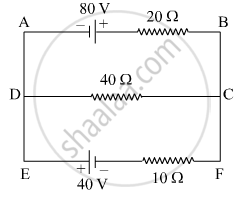
Using Kirchhoff’s rules, calculate the current through the 40 Ω and 20 Ω resistors in the following circuit.
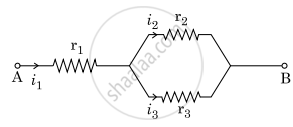
Three resistors having resistances r1, r2 and r3 are connected as shown in the given circuit. The ratio `"i"_3/"i"_1` of currents in terms of resistances used in the circuit is :
Derive the equation of the balanced state in a Wheatstone bridge using Kirchhoff’s laws.
In the circuit shown in Figure below, E1 and E2 are batteries having emfs of 25V and 26V. They have an internal resistance of 1 Ω and 5 Ω respectively. Applying Kirchhoff’s laws of electrical networks, calculate the currents I1 and I2.

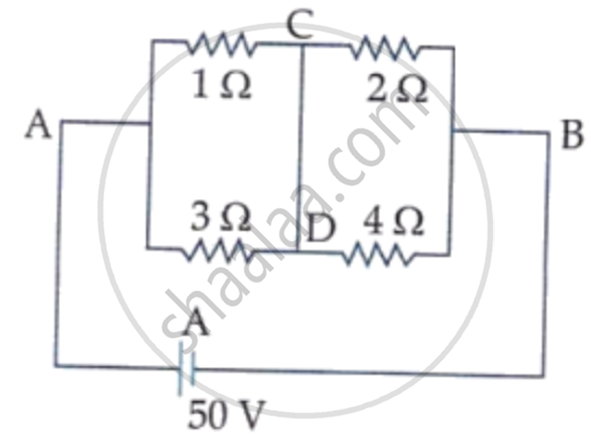
A constant voltage of 50 V is maintained between the points A and B of the circuit shown in the figure. The current through the branch CD of the circuit is:
What is potential difference?
Which sign convention is usually used for current entering a junction?
