Advertisements
Advertisements
Question
A potentiometer wire has a length of 4 m and resistance of 20 Ω. It is connected in series with resistance of 2980 Ω and a cell of emf 4 V. Calculate the potential along the wire.
Advertisements
Solution
Given data:
l = 4m of R = 20Ω
In series with R’ = 2980Ω
E = 4 V
Since 20 is in series with 2980
Reff = 20 + 2980 = 3000
current I = `"V"/"R"_"eff" = 4/3000 = 1.3 xx 10^-3 "A"`
I = `1.3 xx 10^-3`A
Potential along the wire of 4 m length is,
`"V"/"l" - "IR"/"l" = (1.3 xx 10^-3 xx 20)/4`
`= (26 xx 10^-3)/4`
= 6.5 × 10⁻³ Vm-1
`"V"/"l" = 6.5 xx 10^-2 "Vm"^-1`
Potential = `0.65 xx 10^-2 "Vm"^-1`
APPEARS IN
RELATED QUESTIONS
Given the resistances of 1 Ω, 2 Ω, 3 Ω, how will be combine them to get an equivalent resistance of (11/3) Ω?
A capacitor of capacitance 8.0 μF is connected to a battery of emf 6.0 V through a resistance of 24 Ω. Find the current in the circuit (a) just after the connections are made and (b) one time constant after the connections are made.
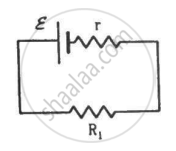
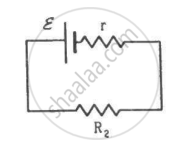
Two unequal resistances, R1 and R2, are connected across two identical batteries of emf ε and internal resistance r (see the figure). Can the thermal energies developed in R1 and R2 be equal in a given time? If yes, what will be the condition?
The instrument for the accurate measurement of the e.m.f of a cell is ______.
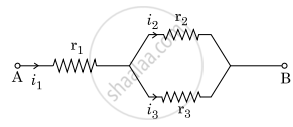
Three resistors having resistances r1, r2 and r3 are connected as shown in the given circuit. The ratio `"i"_3/"i"_1` of currents in terms of resistances used in the circuit is :
The value of current in the 6Ω resistance is ______.

In the circuit shown in Figure below, E1 and E2 are batteries having emfs of 25V and 26V. They have an internal resistance of 1 Ω and 5 Ω respectively. Applying Kirchhoff’s laws of electrical networks, calculate the currents I1 and I2.

The figure below shows two batteries, E1 and E2, having emfs of 18V and 10V and internal resistances of 1 Ω and 2 Ω, respectively. W1, W2 and W3 are uniform metallic wires AC, FD and BE having resistances of 8 Ω, 6 Ω and 10 Ω respectively. B and E are midpoints of the wires W1 and W2. Using Kirchhoff's laws of electrical circuits, calculate the current flowing in the wire W3:

Which sign convention is usually used for current leaving a junction?
