Advertisements
Advertisements
Question
On which conservation principle is Kirchoff's Second Law of electrical networks based?
Advertisements
Solution
Kirchoff's Second Law state about law of conservation of energy.
APPEARS IN
RELATED QUESTIONS
State the two Kirchhoff’s rules used in electric networks. How are there rules justified?
State Kirchhoff's rules and explain on what basis they are justified.
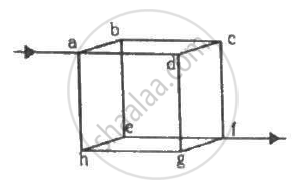
Twelve wires, each of equal resistance r, are joined to form a cube, as shown in the figure. Find the equivalent resistance between the diagonally-opposite points a and f.
Lightning is a very good example of a natural current. In typical lightning, there is 109 J energy transfer across the potential difference of 5 × 10⁷ V during a time interval of 0.2 s. Using this information, estimate the following quantities:
- the total amount of charge transferred between cloud and ground
- the current in the lightning bolt
- the power delivered in 0.2 s.

Figure shows current in a part of an electrical circuit. Then current I is ______.

The Kirchhoff's second law (ΣiR = ΣE), where the symbols have their usual meanings, is based on ______.
A 6-volt battery is connected to the terminals of a three-metre-long wire of uniform thickness and resistance of 100 ohms. The difference of potential between two points on the wire separated by a distance of 50 cm will be ______.
The figure below shows two batteries, E1 and E2, having emfs of 18V and 10V and internal resistances of 1 Ω and 2 Ω, respectively. W1, W2 and W3 are uniform metallic wires AC, FD and BE having resistances of 8 Ω, 6 Ω and 10 Ω respectively. B and E are midpoints of the wires W1 and W2. Using Kirchhoff's laws of electrical circuits, calculate the current flowing in the wire W3:

In a closed loop containing cells and resistors, what equals the total potential drop across the resistors?
While moving opposite to the direction of current through a resistor, how is the potential change treated?
