Advertisements
Advertisements
प्रश्न
A potentiometer wire has a length of 4 m and resistance of 20 Ω. It is connected in series with resistance of 2980 Ω and a cell of emf 4 V. Calculate the potential along the wire.
Advertisements
उत्तर
Given data:
l = 4m of R = 20Ω
In series with R’ = 2980Ω
E = 4 V
Since 20 is in series with 2980
Reff = 20 + 2980 = 3000
current I = `"V"/"R"_"eff" = 4/3000 = 1.3 xx 10^-3 "A"`
I = `1.3 xx 10^-3`A
Potential along the wire of 4 m length is,
`"V"/"l" - "IR"/"l" = (1.3 xx 10^-3 xx 20)/4`
`= (26 xx 10^-3)/4`
= 6.5 × 10⁻³ Vm-1
`"V"/"l" = 6.5 xx 10^-2 "Vm"^-1`
Potential = `0.65 xx 10^-2 "Vm"^-1`
APPEARS IN
संबंधित प्रश्न
Given the resistances of 1 Ω, 2 Ω, 3 Ω, how will be combine them to get an equivalent resistance of (11/5) Ω?
Calculate the value of the resistance R in the circuit shown in the figure so that the current in the circuit is 0.2 A. What would b the potential difference between points A and B?

How the emf of two cells are compared using potentiometer?
Lightning is a very good example of a natural current. In typical lightning, there is 109 J energy transfer across the potential difference of 5 × 10⁷ V during a time interval of 0.2 s. Using this information, estimate the following quantities:
- the total amount of charge transferred between cloud and ground
- the current in the lightning bolt
- the power delivered in 0.2 s.

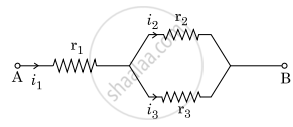
Three resistors having resistances r1, r2 and r3 are connected as shown in the given circuit. The ratio `"i"_3/"i"_1` of currents in terms of resistances used in the circuit is :
What is the advantage of using thick metallic strips to join wires in a potentiometer?
In the circuit shown in Figure below, E1 and E2 are batteries having emfs of 25V and 26V. They have an internal resistance of 1 Ω and 5 Ω respectively. Applying Kirchhoff’s laws of electrical networks, calculate the currents I1 and I2.

Which term is defined as the rate of flow of charge through a conductor?
Which sign convention is usually used for current leaving a junction?
While moving opposite to the direction of current through a resistor, how is the potential change treated?
