Advertisements
Advertisements
प्रश्न
Twelve wires each having a resistance of 3 Ω are connected to form a cubical network. A battery of 10 V and negligible internal resistance is connected across the diagonally opposite corners of this network. Determine its equivalent resistance and the current along each edge of the cube.
Advertisements
उत्तर
A battery of 10 V is connected across the diagonally opposite points a and f of the given network. Each side of the cube represents a 3-ohm resistor. Current entrees through the point a and leaves through the point f. Let I current is drawn from the battery and enters through point a, due to the symmetry of cube between point a and f, the current will divide itself into equal parts at each corner of the cube.
As you can see in the figure given below:
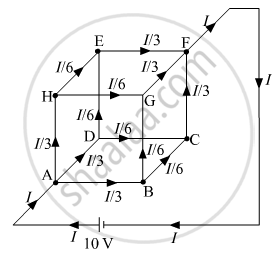
If we consider the current path ABGFA, then we can write, VA-B + VB-G + VG-F = V
⇒ `("I"/3 xx"R") + ("I"/6 xx "R") + ("I"/3 xx "R") = ("I" xx "R"_"net")`
⇒ `"R"_"net" = "R"/3 + "R"/6 + "R"/3 = (5"R")/6`
∵ R = 3Ω
⇒ `"R"_"net" = (5xx3)/6 = 2.5 Ω`
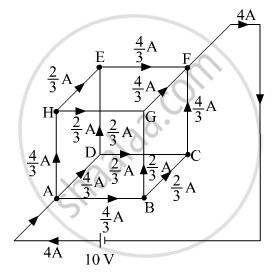
Current, `"i" = "V"/"R"_"net" = 10/2.5 = 4 "A"`
⇒ i = 4 A
As i = 4 A, hence current through each side of the cube can be marked. The below figure shows the current through each resistance of the network. i.e. each side of the cube.
APPEARS IN
संबंधित प्रश्न
Kirchhoff's voltage law and current law are respectively in accordance with the conservation of .................................. .
- charge and momentum
- charge and energy
- energy and charge
- energy and momentum
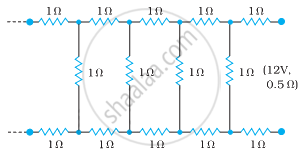
Determine the current drawn from a 12 V supply with internal resistance 0.5 Ω by the infinite network shown in the figure. Each resistor has 1 Ω resistance.
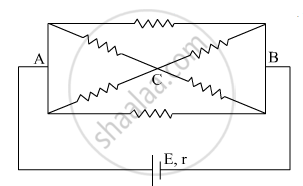
The current is drawn from a cell of emf E and internal resistance r connected to the network of resistors each of resistance r as shown in the figure. Obtain the expression for
- the current draw from the cell and
- the power consumed in the network.
Given the resistances of 1 Ω, 2 Ω, 3 Ω, how will be combine them to get an equivalent resistance of (6/11) Ω?
Calculate the value of the resistance R in the circuit shown in the figure so that the current in the circuit is 0.2 A. What would b the potential difference between points B and E?

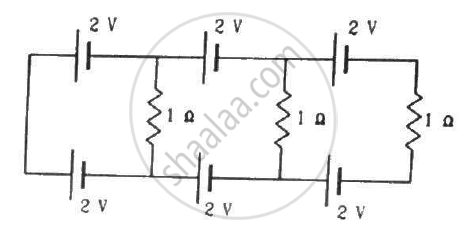
Find the circuit in the three resistors shown in the figure.
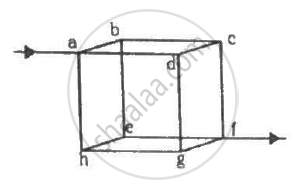
Twelve wires, each of equal resistance r, are joined to form a cube, as shown in the figure. Find the equivalent resistance between the diagonally-opposite points a and f.
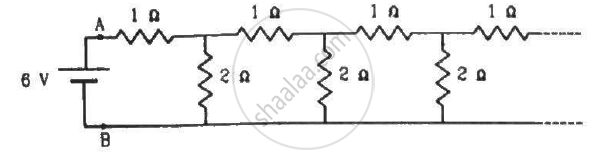
An infinite ladder is constructed with 1 Ω and 2 Ω resistors, as shown in the figure. (a) Find the effective resistance between the points A and B. (b) Find the current that passes through the 2 Ω resistor nearest to the battery.
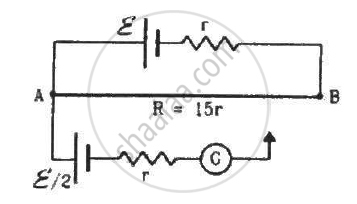
Consider the potentiometer circuit as arranged in the figure. The potentiometer wire is 600 cm long. (a) At what distance from the point A should the jockey touch the wire to get zero deflection in the galvanometer? (b) If the jockey touches the wire at a distance of 560 cm from A, what will be the current in the galvanometer?
A copper wire of 10-6 m2 area of cross-section, carries a current of 2 A. If the number of electrons per cubic meter is 8 × 1028, calculate the current density and average drift velocity.
The e.m.f of The battery in a thermocouple is doubled. The rate of heat generated at one of the junction will.
What is the advantage of using thick metallic strips to join wires in a potentiometer?
The circuit in figure shows two cells connected in opposition to each other. Cell E1 is of emf 6V and internal resistance 2Ω; the cell E2 is of emf 4V and internal resistance 8Ω. Find the potential difference between the points A and B.
A 6-volt battery is connected to the terminals of a three-metre-long wire of uniform thickness and resistance of 100 ohms. The difference of potential between two points on the wire separated by a distance of 50 cm will be ______.
What is Kirchhoff's Current Law also called?
Which pair of equations expresses the loop relationship for cells and resistors?
Which term is defined as the rate of flow of charge through a conductor?
Why must the amount of charge entering a junction per second equal the amount leaving when current is steady?
What is the sign of the emf when moving from the negative terminal to the positive terminal of a cell?
