Advertisements
Advertisements
प्रश्न
Calculate the value of the resistance R in the circuit shown in the figure so that the current in the circuit is 0.2 A. What would b the potential difference between points A and B?

Advertisements
उत्तर

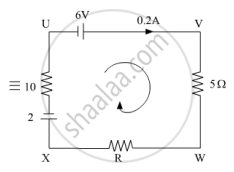
Apply Kirchhoff’s loop law in loop UVWXU:-
5(0.2) + R (0.2) + 10(0.2) = 6 − 2
⇒ R = 5Ω
VAB = VVW 5(0.2) = 1V
APPEARS IN
संबंधित प्रश्न
Kirchhoff's voltage law and current law are respectively in accordance with the conservation of .................................. .
- charge and momentum
- charge and energy
- energy and charge
- energy and momentum
Kirchhoff's junction law is equivalent to .............................
(a) conservation of energy.
(b) conservation of charge
(c) conservation of electric potential
(d) conservation of electric flux
Given n resistors each of resistance R, how will you combine them to get the (i) maximum (ii) minimum effective resistance? What is the ratio of the maximum to minimum resistance?
Given the resistances of 1 Ω, 2 Ω, 3 Ω, how will be combine them to get an equivalent resistance of 6 Ω?
Determine the equivalent resistance of networks shown in Fig.
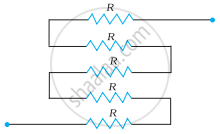
Find the circuit in the three resistors shown in the figure.
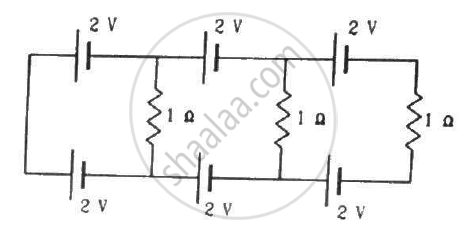
On which conservation principle is Kirchoff's Second Law of electrical networks based?
In the circuit shown in the figure below, E1 and E2 are two cells having emfs 2 V and 3 V respectively, and negligible internal resistance. Applying Kirchhoff’s laws of electrical networks, find the values of currents l1 and I2.

State and explain Kirchhoff’s rules.
Obtain the condition for bridge balance in Wheatstone’s bridge.
Kirchhoff’s junction rule is a reflection of ______.
- conservation of current density vector.
- conservation of charge.
- the fact that the momentum with which a charged particle approaches a junction is unchanged (as a vector) as the charged particle leaves the junction.
- the fact that there is no accumulation of charges at a junction.
Why are alloys used for making standard resistance coils?
Derive the equation of the balanced state in a Wheatstone bridge using Kirchhoff’s laws.
The figure below shows two batteries, E1 and E2, having emfs of 18V and 10V and internal resistances of 1 Ω and 2 Ω, respectively. W1, W2 and W3 are uniform metallic wires AC, FD and BE having resistances of 8 Ω, 6 Ω and 10 Ω respectively. B and E are midpoints of the wires W1 and W2. Using Kirchhoff's laws of electrical circuits, calculate the current flowing in the wire W3:

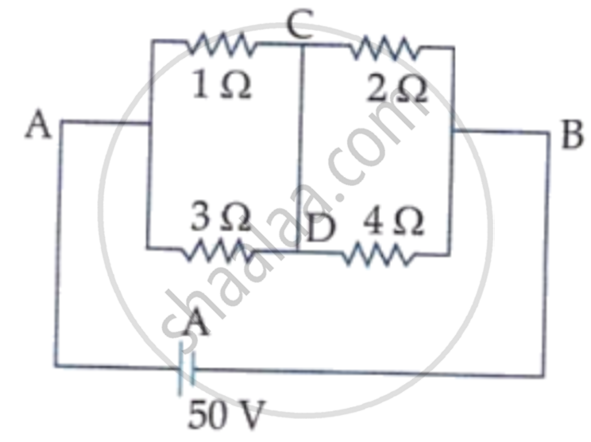
A constant voltage of 50 V is maintained between the points A and B of the circuit shown in the figure. The current through the branch CD of the circuit is:
At any junction, what does Kirchhoff's Current Law state?
What is a loop?
Why must the amount of charge entering a junction per second equal the amount leaving when current is steady?
Which sign convention is usually used for current entering a junction?
