Advertisements
Advertisements
प्रश्न
Use Kirchhoff's rules to obtain conditions for the balance condition in a Wheatstone bridge.
Advertisements
उत्तर
Let us consider a Wheatstone bridge arrangement as shown below.
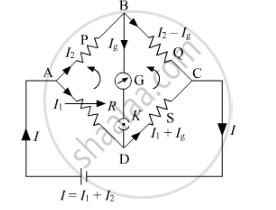
Applying Kirchhoff's loop law to the closed loop ADBA, we get
I1R−IgG−I2P=0 .....(1)
Here, G is the resistance of the galvanometer.
Applying Kirchhoff's loop law in the closed loop BDCB, we get
IgG+(I1+Ig)S−(I2−Ig)Q=0.....(2)
When the Wheatstone bridge is balanced, no current flows through the galvanometer, i.e. Ig=0
∴ From (1), we get
I1R−I2P=0
⇒I1R=I2P
`=>I_1/I_2=P/R" ......(3)"`
Similarly, from (2), we get
I1S−I2Q=0
⇒I1S=I2Q
`=>I_1/I_2=Q/S" .....(4)"`
From (3) and (4), we get
`P/R=Q/S`
or `P/Q=R/S`
This is the required balance condition in a Wheatstone bridge arrangement.
APPEARS IN
संबंधित प्रश्न
Given n resistors each of resistance R, how will you combine them to get the (i) maximum (ii) minimum effective resistance? What is the ratio of the maximum to minimum resistance?
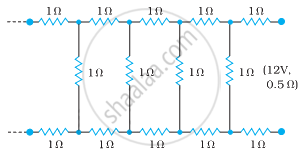
Determine the current drawn from a 12 V supply with internal resistance 0.5 Ω by the infinite network shown in the figure. Each resistor has 1 Ω resistance.
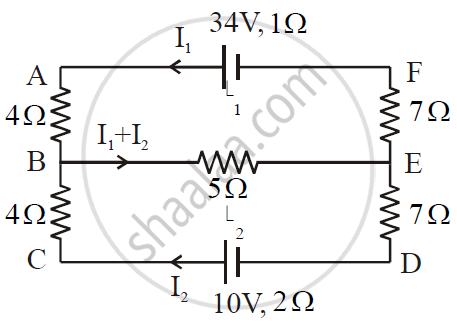
ε1 and ε2 are two batteries having emf of 34V and 10V respectively and internal resistance of 1Ω and 2Ω respectively. They are connected as shown in the figure below. Using Kirchhoff’s Laws of electrical networks, calculate the currents I1 and I2.
State Kirchhoff's rules and explain on what basis they are justified.
Given the resistances of 1 Ω, 2 Ω, 3 Ω, how will be combine them to get an equivalent resistance of (11/3) Ω?
Using Kirchhoff’s rules determine the value of unknown resistance R in the circuit so that no current flows through 4 Ω resistance. Also find the potential difference between A and D.
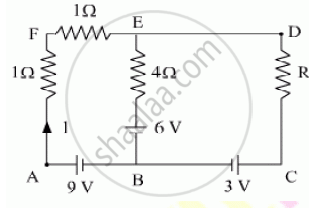
Calculate the value of the resistance R in the circuit shown in the figure so that the current in the circuit is 0.2 A. What would b the potential difference between points A and B?

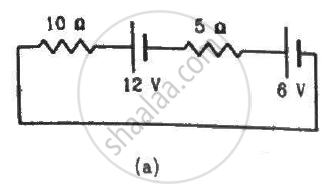
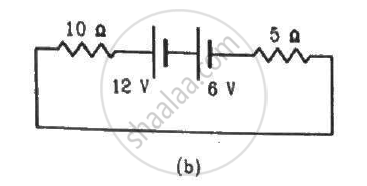
Consider the circuit shown in the figure. Find (a) the current in the circuit (b) the potential drop across the 5 Ω resistor (c) the potential drop across the 10 Ω resistor (d) Answer the parts (a), (b) and (c) with reference to the figure.
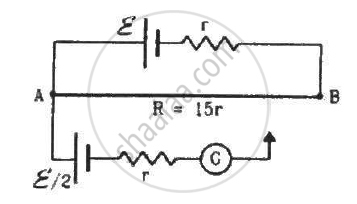
Consider the potentiometer circuit as arranged in the figure. The potentiometer wire is 600 cm long. (a) At what distance from the point A should the jockey touch the wire to get zero deflection in the galvanometer? (b) If the jockey touches the wire at a distance of 560 cm from A, what will be the current in the galvanometer?
State Kirchhoff’s current rule.
State the principle of potentiometer.
Obtain the condition for bridge balance in Wheatstone’s bridge.
A potentiometer wire has a length of 4 m and resistance of 20 Ω. It is connected in series with resistance of 2980 Ω and a cell of emf 4 V. Calculate the potential along the wire.
In a potentiometer arrangement, a cell of emf 1.25 V gives a balance point at 35 cm length of the wire. If the cell is replaced by another cell and the balance point shifts to 63 cm, what is the emf of the second cell?
The instrument for the accurate measurement of the e.m.f of a cell is ______.
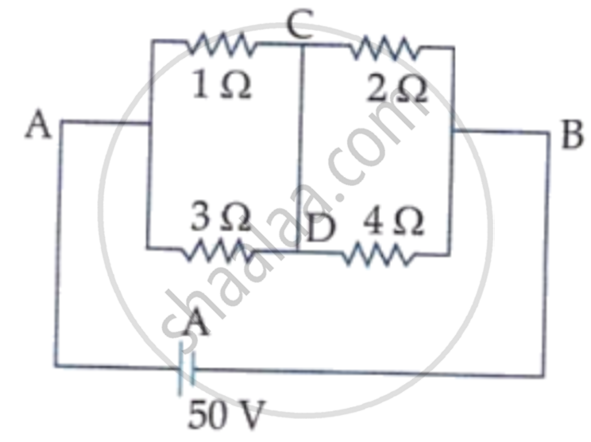
A constant voltage of 50 V is maintained between the points A and B of the circuit shown in the figure. The current through the branch CD of the circuit is:
What is the sign of the emf when moving from the negative terminal to the positive terminal of a cell?
