Advertisements
Advertisements
प्रश्न
A copper wire of 10-6 m2 area of cross-section, carries a current of 2 A. If the number of electrons per cubic meter is 8 × 1028, calculate the current density and average drift velocity.
Advertisements
उत्तर
A = 10-6 m2, I = 2A, n = 8 × 1028
Formula:
Current density, J = J = `"I"/"A"`
Drift velocity, `"V"_"d" = "J"/"ne"`
J = `"I"/"A" = 2/10^-6 = 2 xx 10^6`
J = `2xx10^6 "Am"^-2`
`"V"_"d" = "J"/"ne" = (2 xx 10^6)/(8 xx 10^28 xx 1.6 xx 10^-6)`
`"V"_"d" = = 0.1562 xx 10^-3`
`"V"_"d" = 15.6 xx 10^-5 "ms"^-1`
APPEARS IN
संबंधित प्रश्न
Kirchhoff's junction law is equivalent to .............................
(a) conservation of energy.
(b) conservation of charge
(c) conservation of electric potential
(d) conservation of electric flux
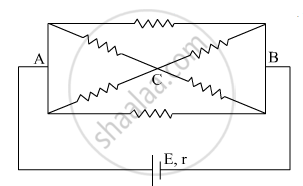
The current is drawn from a cell of emf E and internal resistance r connected to the network of resistors each of resistance r as shown in the figure. Obtain the expression for
- the current draw from the cell and
- the power consumed in the network.
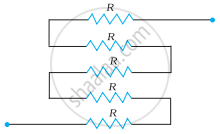
Determine the equivalent resistance of networks shown in Fig.
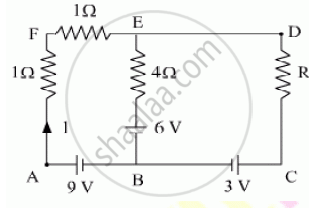
Using Kirchhoff’s rules determine the value of unknown resistance R in the circuit so that no current flows through 4 Ω resistance. Also find the potential difference between A and D.
A capacitor of capacitance 8.0 μF is connected to a battery of emf 6.0 V through a resistance of 24 Ω. Find the current in the circuit (a) just after the connections are made and (b) one time constant after the connections are made.
A potentiometer wire has a length of 4 m and resistance of 20 Ω. It is connected in series with resistance of 2980 Ω and a cell of emf 4 V. Calculate the potential along the wire.
The instrument for the accurate measurement of the e.m.f of a cell is ______.
The Kirchhoff's second law (ΣiR = ΣE), where the symbols have their usual meanings, is based on ______.
While measuring the length of the rod by vernier callipers, the reading on the main scale is 6.4 cm and the eight divisions on vernier is in line with marking on the main scale division. If the least count of callipers is 0.01 and zero error - 0.04 cm, the length of the rod is ______.
How are Kirchhoff's laws used in analysing a general network with several unknown branch currents?
