Advertisements
Advertisements
प्रश्न
The resistance of a nichrome wire at 0°C is 10Ω. If its temperature coefficient of resistivity of nichrome is 0.004/ °C, find its resistance of the wire at boiling point of water. Comment on the result.
Advertisements
उत्तर
Given data:
R0 = 10Ω
The boiling point of water T = 100°C
α = 0.004°C
RT = ?
Formula:
RT = R0 [l + αT)]
RT = 10 [1 + (0.004 × 100)]
= 10(1 + 0.4)
= 10 (1.4)
RT = 14Ω
As the temperature increase the resistance of the wire also increases.
APPEARS IN
संबंधित प्रश्न
If the potential difference across the ends of a conductor is 220 V and the resistance of the conductor is 44 Ω (ohm), then the current flowing through is _________.
- 0.2 A
- 0.5 A
- 2 A
- 5 A
Will current flow more easily through a thick wire or a thin wire of the same material, when connected to the same source? Why?
When a 12 V battery is connected across an unknown resistor, there is a current of 2.5 mA in the circuit. Find the value of the resistance of the resistor.
What is Resistivity?
Write the SI unit of resistivity
The resistors R1, R2, R3 and R4 in the figure given below are all equal in value.
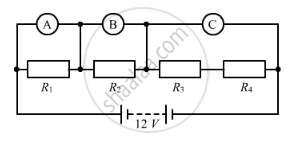
What would you expect the voltmeter A, B and C to read assuming that the connecting wires in the circuit have negligible resistance?
An ammeter placed in series with an electric radiator reads 0.5 amps and a voltmeter placed across it reads 230 volts. What is the resistance of the radiator?
For a continuous current flow through a conductor, what must be maintained across the ends of the conductor?
If the voltage across a conductor is increased while its temperature remains unchanged, what happens to the current flowing through it?
