Advertisements
Advertisements
प्रश्न
The unit of electrical resistance is:
(a) ampere
(b) volt
(c) coulomb
(d) ohm
Advertisements
उत्तर
(d) ohm
The unit of electrical resistance is ohm.
APPEARS IN
संबंधित प्रश्न
Name the physical quantity whose unit is "ohm".
The graph between V and I for a conductor is a straight line passing through the origin.
What should remain constant in a statement of this law?
What is the necessary condition for a conductor to obey Ohm’s law?
In a conductor 6.25 × `10^16` electrons flow from its end A to B in 2 s. Find the current flowing through the conductor (e = 1.6 × `10^-19` C)
A wire of resistance 3 ohm and length 10 cm is stretched to length 30 cm. Assuming that it has a uniform cross section, what will be its new resistance?
A wire of resistance 9 ohm having length 30 cm is tripled on itself. What is its new resistance?
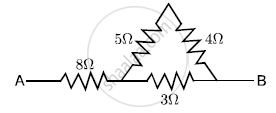
Calculate the effective resistance across AB?
- Name and state the law which relates the potential difference and current in a conductor.
- What is the necessary condition for a conductor to obey the law named above in part (a) ?
State and define Ohm’s law.
What is non-ohmic resistor?
Answer the following question.
Distinguish between Ohmic and non-ohmic substances; explain with the help of example.
The ratio of the potential difference to the current is known as ________.
Write a short note on superconductors?
State Ohm’s law? How can it be verified experimentally? Does it hold good under all conditions? Comment.

Calculate the total resistance of the circuit and find the total current in the circuit.
Ohm's law deals with the relationship between ______
How is electric current related to the potential difference across the terminals of a conductor?
Draw a labelled circuit diagram to verify this relationship.
The mathematical form of Ohm's Law is:
In which unit is the resistance of a conductor measured?
