Advertisements
Advertisements
प्रश्न
Define ampere and volt with respect to Ohm’s law.
Advertisements
उत्तर
Ampere: It is the S.I. unit of current. If a current flows in a conductor of resistance of 1Ω, when the potential difference across its ends is 1 volt, the current is said to be 1 ampere, i.e.,
1 ampere = 1 volt/1 ohm
Volt: It is the S. I. unit of potential difference. If a current of 1 ampere flows in a conductor of resistance 1 ohm, then potential difference across its ends is said to be 1 volt, i.e.,
1 volt = 1 ampere × 1 ohm.
संबंधित प्रश्न
Write the formula of resistivity
How should the two resistances of 2 ohms each be connected so as to produce an equivalent resistance of 1 ohm?
The resistors R1, R2, R3 and R4 in the figure given below are all equal in value.
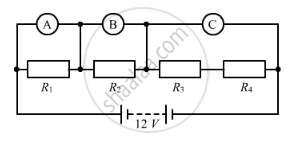
What would you expect the voltmeter A, B and C to read assuming that the connecting wires in the circuit have negligible resistance?
Which of the following is an ohmic resistance?
An electric bulb draws 1.2 A current at 6.0 V. Find the resistance of filament of bulb while glowing.
State the relation correlating the electric current flowing in a conductor and the voltage applied across it. Also, draw a graph to show this relationship.
What are ohmic conductors? Give one exmaple. Draw a graph showing the current-voltage relationship for an ohmic conductor.
Obtain the macroscopic form of Ohm’s law from its microscopic form and discuss its limitation.
The temperature of a conductor is increased. The graph best showing the variation of its resistance is:
Which formula is used with Ohm's Law to help determine power consumption in an electrical circuit?
