Advertisements
Advertisements
Question
Define ampere and volt with respect to Ohm’s law.
Advertisements
Solution
Ampere: It is the S.I. unit of current. If a current flows in a conductor of resistance of 1Ω, when the potential difference across its ends is 1 volt, the current is said to be 1 ampere, i.e.,
1 ampere = 1 volt/1 ohm
Volt: It is the S. I. unit of potential difference. If a current of 1 ampere flows in a conductor of resistance 1 ohm, then potential difference across its ends is said to be 1 volt, i.e.,
1 volt = 1 ampere × 1 ohm.
RELATED QUESTIONS
The unit of electrical resistance is:
(a) ampere
(b) volt
(c) coulomb
(d) ohm
A wire of resistance 9 ohm having length 30 cm is tripled on itself. What is its new resistance?
How does an increase in the temperature affect the specific resistance of a semiconductor?
A metal sphere is kept on an insulting stands. A negatively charged rod is brought near it, then the sphere is earthed as shown. On removing the earthing, and taking the negatively charged rod away, what will be the nature of charge on the sphere? Give reason for your answer.

Fig. represents the circuit used for the verification of Ohm's law. Label the parts from A to F. state the function of each.
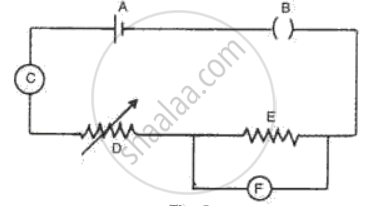
- Name and state the law which relates the potential difference and current in a conductor.
- What is the necessary condition for a conductor to obey the law named above in part (a) ?
The filament of a bulb takes a current 100 mA when potential difference across it is 0.2 V. When the potential difference across it becomes 1.0 V, the current becomes 400 mA. Calculate the resistance of filament in each case and account for the difference.
State and define Ohm’s law.
What are ohmic conductors? Give one exmaple. Draw a graph showing the current-voltage relationship for an ohmic conductor.
Let the resistance of an electrical device remain constant, while the potential difference across its two ends decreases to one fourth of its initial value. What change will occur in the current through it? State the law which helps us in solving the above stated question.
