Advertisements
Advertisements
Question
In the circuit shown below in Fig, calculate the value of x if the equivalent resistance between A and B is 4 Ω.

Advertisements
Solution
r1 = 4 Ω
r2 = 8 Ω
r3 = x Ω
r4 = 5 Ω
Rs1 = r1+r2
= 4 + 8
= 12 Ω
Rs2 = r3 + r4
= x + 5 Ω
`1/"R" =1/"Rs"_1 + 1/"Rs"_2`
`1/4 = 1/12 + 1/(5+x)`
`1/6=1/(5+x)`
x = 1 Ω
APPEARS IN
RELATED QUESTIONS
A wire has a length of 2.0 m and a resistance of 5.0 Ω. Find the electric field existing inside the wire if it carries a current of 10 A.
Define the following:
Coulomb
What is meant by the drift speed of free electrons?
Define Current density.
A metal rod of length 10 cm and a rectangular cross-section of 1 cm × `1/2` cm is connected to a battery across opposite faces. The resistance will be ______.
The resistance of a resistor is reduced to half of its initial value. If other parameters of the electrical circuit remain unaltered, the amount of heat produced in the resistor will become ______.
The circuit depicted in the figure is employed for studying Ohm’s Law. Instead of using a standard resistor, a student opts for a glass tube filled with mercury (tube 1), connected to the circuit through two electrodes, E1 and E2. He records the readings of the ammeter and voltmeter, thereby calculating the resistance. The student repeats the experiment by substituting tube 1 with tube 2, where the same amount of mercury fills tube 2.
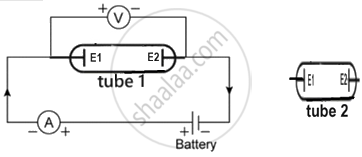
Neglecting internal resistance of the cell use (> or < or =) to compare:
- the resistance in both the cases.
- the voltmeter readings in both the cases.
- the specific resistance in both the cases.
Which of the following is an example of a Non-Ohmic material?
A resistor is connected in a circuit with a voltage of 12 V and a resistance of 24 Ω. What is the current flowing through the resistor?
