Advertisements
Advertisements
Question
In a conductor 6.25 × `10^16` electrons flow from its end A to B in 2 s. Find the current flowing through the conductor (e = 1.6 × `10^-19` C)
Advertisements
Solution
Number of electrons flowing through the conductor,
N = `6.25 × 10^16` electrons
Time taken, t = 2 s
Given, e = `1.6 × 10^-19` C
Let I be the current flowing through the conductor.
Then, I = `"ne"/t`
∴ I = `((6.25 xx 10^16)(1.6 xx10^-19))/2`
= ` 5 xx 10^-3`A
Or, I = 5 mA
Thus, 5 mA current flows from B to A.
APPEARS IN
RELATED QUESTIONS
A wire of resistance 3 ohm and length 10 cm is stretched to length 30 cm. Assuming that it has a uniform cross section, what will be its new resistance?
In the circuit shown below in Fig, calculate the value of x if the equivalent resistance between A and B is 4 Ω.

A metal sphere is kept on an insulting stands. A negatively charged rod is brought near it, then the sphere is earthed as shown. On removing the earthing, and taking the negatively charged rod away, what will be the nature of charge on the sphere? Give reason for your answer.

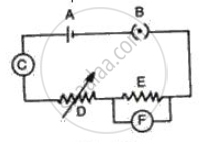
Fig. represents the circuit used for the verification of ohm's law. Label the different parts from A and F. State the function of each.
An ammeter placed in series with an electric radiator reads 0.5 amps and a voltmeter placed across it reads 230 volts. What is the resistance of the radiator?
Ohm’s law states the relationship between power and voltage.
State microscopic form of Ohm’s law.
The unit of specific resistance is ____________.
The temperature of a conductor is increased. The graph best showing the variation of its resistance is:
