Advertisements
Advertisements
Question
A current of 3.2 mA flows through a conductor. If charge on an electron is −1.6 × 10⁻¹⁹ coulomb, find the number of electrons that will pass each second through the cross section of that conductor.
Advertisements
Solution
Q = n × e,
C = 3.2 m A = 3.2 × 1000 A,
Q = −1.6 × 10⁻¹⁹
3.2 × 1000 = n × −1.6 × 10⁻¹⁹
n = `(3.2 × 1000)/(1.6 × 10^-19)`
n = `(3.2 × 10^-3)/(1.6 × 10^-19)`
= `2/(10^-16)`
n = 2 × 10¹⁶
APPEARS IN
RELATED QUESTIONS
Name the physical quantity whose unit is "ohm".
Keeping the p.d. constant, the resistance of a circuit is halved. The current will become:
(a) one-fourth
(b) four time
(c) half
(d) double
The resistors R1, R2, R3 and R4 in the figure given below are all equal in value.
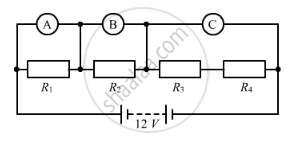
What would you expect the voltmeter A, B and C to read assuming that the connecting wires in the circuit have negligible resistance?
A resistance of 40 ohms and one of 60 ohms are arranged in series across 220 volt supply. Find the heat in joules produced by this combination of resistances in half a minute.
Ohm’s law states the relationship between power and voltage.
State Ohm’s law? How can it be verified experimentally? Does it hold good under all conditions? Comment.
The heat produced by a 100 w heater in 2 minute is equal to
Two cells of same emf E but internal resistance r1 and r2 are connected in series to an external resistor R (Figure). What should be the value of R so that the potential difference across the terminals of the first cell becomes zero.
When two conductors at different electric potentials are joined by a metallic wire, in which direction do the electrons flow?
From Ohm's Law, since \[I \propto V\], the constant ratio \[\frac{V}{I}\] is defined as:
