Advertisements
Advertisements
प्रश्न
A current of 3.2 mA flows through a conductor. If charge on an electron is −1.6 × 10⁻¹⁹ coulomb, find the number of electrons that will pass each second through the cross section of that conductor.
Advertisements
उत्तर
Q = n × e,
C = 3.2 m A = 3.2 × 1000 A,
Q = −1.6 × 10⁻¹⁹
3.2 × 1000 = n × −1.6 × 10⁻¹⁹
n = `(3.2 × 1000)/(1.6 × 10^-19)`
n = `(3.2 × 10^-3)/(1.6 × 10^-19)`
= `2/(10^-16)`
n = 2 × 10¹⁶
APPEARS IN
संबंधित प्रश्न
A low voltage supply from which one needs high currents must have very low internal resistance. Why?
The graph between V and I for a conductor is a straight line passing through the origin.
- Which law is illustrated by such a graph?
- What should remain constant in a statement of this law?
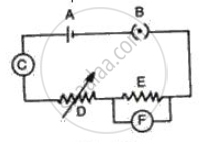
Fig. represents the circuit used for the verification of ohm's law. Label the different parts from A and F. State the function of each.
Rewrite the following statement by selecting the correct option.
The S.I. unit of resistance is __________.
The ratio of the potential difference to the current is known as ________.
The variable resistance is called ____________.
Two cells of same emf E but internal resistance r1 and r2 are connected in series to an external resistor R (Figure). What should be the value of R so that the potential difference across the terminals of the first cell becomes zero.
The voltage - current readings of a certain material are shown in the table given below:
| Voltage (V) | 10 V | 20 V | 30 V |
| Current (I) | 2 A | 3 A | 4 A |
Study the table.
- State whether the conductor used is ohmic or non-ohmic.
- Justify your answer.
- State Ohm's law.
Ohm's Law states that for a metallic conductor, the current flowing through it is directly proportional to the potential difference across its ends, provided that:
Which of the following correctly defines Potential Difference (V) as one of the three core quantities of Ohm's Law?
