Advertisements
Advertisements
प्रश्न
A current of 3.2 mA flows through a conductor. If charge on an electron is −1.6 × 10⁻¹⁹ coulomb, find the number of electrons that will pass each second through the cross section of that conductor.
Advertisements
उत्तर
Q = n × e,
C = 3.2 m A = 3.2 × 1000 A,
Q = −1.6 × 10⁻¹⁹
3.2 × 1000 = n × −1.6 × 10⁻¹⁹
n = `(3.2 × 1000)/(1.6 × 10^-19)`
n = `(3.2 × 10^-3)/(1.6 × 10^-19)`
= `2/(10^-16)`
n = 2 × 10¹⁶
APPEARS IN
संबंधित प्रश्न
A low voltage supply from which one needs high currents must have very low internal resistance. Why?
Name the unit of electrical resistance and give its symbol.
Keeping the p.d. constant, the resistance of a circuit is halved. The current will become:
(a) one-fourth
(b) four time
(c) half
(d) double
The resistors R1, R2, R3 and R4 in the figure given below are all equal in value.
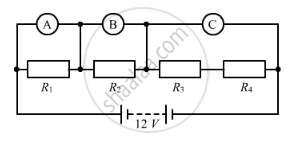
What would you expect the voltmeter A, B and C to read assuming that the connecting wires in the circuit have negligible resistance?
How much energy is consumed when a current of 5 amperes flows through the filament (or element) of a heater having resistance of 100 ohms for two hours? Express it in joules.
A resistance of 40 ohms and one of 60 ohms are arranged in series across 220 volt supply. Find the heat in joules produced by this combination of resistances in half a minute.
- Draw a V-I graph for a conductor obeying Ohm’s law.
- What does the slope of V–I graph for a conductor represent?
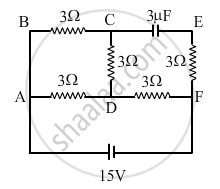
In the circuit shown in the figure, find the total resistance of the circuit and the current in the arm AD.
Two conductors are made of the same material and have the same length. Conductor A is a solid wire of diameter 1 mm. Conductor B is a hollow tube of outer diameter 2 mm and inner diameter 1 mm. Find the ratio of resistance RA to RB.
The electric current between two joined conductors at different potentials continues to flow until:
