Advertisements
Advertisements
प्रश्न
A wire has a length of 2.0 m and a resistance of 5.0 Ω. Find the electric field existing inside the wire if it carries a current of 10 A.
Advertisements
उत्तर
Given:-
Length of the wire, l = 2 m
Resistance of the wire, R = 5 Ω
Current through the wire, i = 10 A
From Ohm's Law, the potential difference across the wire,
V = iR
∴ V= 10 × 5 = 50 V
Electric field,
\[E = \frac{V}{l}\]
\[ = \frac{50}{2}\]
\[ = 25 V/m\]
APPEARS IN
संबंधित प्रश्न
Keeping the p.d. constant, the resistance of a circuit is halved. The current will become:
(a) one-fourth
(b) four time
(c) half
(d) double
Four resistances of 16 ohms each are connected in parallel. Four such combinations are connected in series. What is the total resistance?
Which of the following is an ohmic resistance?
An electric bulb draws 1.2 A current at 6.0 V. Find the resistance of filament of bulb while glowing.
Calculate the current flowing through a wire of resistance 5 Ω connected to a battery of potential difference 3 V.
In an experiment of verification of Ohm’s law following observations are obtained.
|
Potential difference V (in volt) |
0.5 | 1.0 | 1.5 | 2.0 | 2.5 |
| current I (in ampere) | 0.2 | 0.4 | 0.6 | 0.8 | 1.0 |
Draw a V-I graph and use this graph to find:
- the potential difference V when the current I is 0.5 A,
- the current I when the potential difference V is 0.75 V,
- the resistance in a circuit.
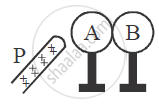
Two metallic spheres A and B kept on insulating stands are in contact with each other. A positively charged rod P is brought near the sphere A as shown in the figure. The two spheres are separated from each other, and the rod P is removed. What will be the nature of charges on spheres A and B?
Consider the sacle of voltmeter shown in the diagram and answer the following questions :

(a) What is the least count of the voltmeter?
(b) What is the reading shown by the voltmeter ?
(c) If the voltmeter is connected across a resistor of 20 `Omega` how much current is flowing through the resistor?
The filament of a bulb takes a current 100 mA when potential difference across it is 0.2 V. When the potential difference across it becomes 1.0 V, the current becomes 400 mA. Calculate the resistance of filament in each case and account for the difference.
What is meant by the drift speed of free electrons?
Answer the following question.
Distinguish between Ohmic and non-ohmic substances; explain with the help of example.
The ratio of the potential difference to the current is known as ________.
Explain the equivalent resistance of a parallel resistor network.
The circuit depicted in the figure is employed for studying Ohm’s Law. Instead of using a standard resistor, a student opts for a glass tube filled with mercury (tube 1), connected to the circuit through two electrodes, E1 and E2. He records the readings of the ammeter and voltmeter, thereby calculating the resistance. The student repeats the experiment by substituting tube 1 with tube 2, where the same amount of mercury fills tube 2.
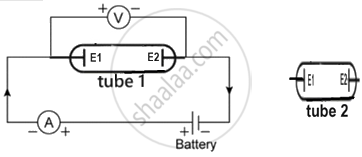
Neglecting internal resistance of the cell use (> or < or =) to compare:
- the resistance in both the cases.
- the voltmeter readings in both the cases.
- the specific resistance in both the cases.
In which unit is the resistance of a conductor measured?
Which of the following is an example of a Non-Ohmic material?
What is the nature of the graph obtained when potential difference is plotted against current for an Ohmic conductor?
Which formula is used with Ohm's Law to help determine power consumption in an electrical circuit?
