Advertisements
Advertisements
Question
A wire has a length of 2.0 m and a resistance of 5.0 Ω. Find the electric field existing inside the wire if it carries a current of 10 A.
Advertisements
Solution
Given:-
Length of the wire, l = 2 m
Resistance of the wire, R = 5 Ω
Current through the wire, i = 10 A
From Ohm's Law, the potential difference across the wire,
V = iR
∴ V= 10 × 5 = 50 V
Electric field,
\[E = \frac{V}{l}\]
\[ = \frac{50}{2}\]
\[ = 25 V/m\]
APPEARS IN
RELATED QUESTIONS
How much energy is consumed when a current of 5 amperes flows through the filament (or element) of a heater having resistance of 100 ohms for two hours? Express it in joules.
Which of the following is an ohmic resistance?
In a conductor 6.25 × `10^16` electrons flow from its end A to B in 2 s. Find the current flowing through the conductor (e = 1.6 × `10^-19` C)
An electric bulb draws 1.2 A current at 6.0 V. Find the resistance of filament of bulb while glowing.
What length of copper wire of resistivity 1.7 × 10⁻⁸ Ω m and radius 1 mm is required so that its resistance is 2Ω?
In the circuit shown below in Fig, calculate the value of x if the equivalent resistance between A and B is 4 Ω.

- Name and state the law which relates the potential difference and current in a conductor.
- What is the necessary condition for a conductor to obey the law named above in part (a) ?
The filament of a bulb takes a current 100 mA when potential difference across it is 0.2 V. When the potential difference across it becomes 1.0 V, the current becomes 400 mA. Calculate the resistance of filament in each case and account for the difference.
State and define Ohm’s law.
Draw a neat diagram for the verification of Ohm’s law by voltmeter-ammeter method. By another diagram show the relation between p.d. and current.
Assertion: The statement of Ohm’s law is K = IR.
Reason: V = IR is the equation which defines resistance.
Ohm's law deals with the relationship between ______
State Ohm's Law. Represent it mathematically.
What is the resistance of a conductor through which a current of 0.5 A flows when a potential difference of 2V is applied across its ends?
Why should an ammeter have low resistance?
The circuit depicted in the figure is employed for studying Ohm’s Law. Instead of using a standard resistor, a student opts for a glass tube filled with mercury (tube 1), connected to the circuit through two electrodes, E1 and E2. He records the readings of the ammeter and voltmeter, thereby calculating the resistance. The student repeats the experiment by substituting tube 1 with tube 2, where the same amount of mercury fills tube 2.
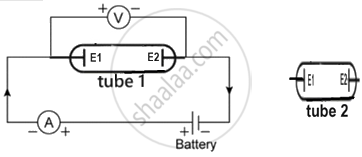
Neglecting internal resistance of the cell use (> or < or =) to compare:
- the resistance in both the cases.
- the voltmeter readings in both the cases.
- the specific resistance in both the cases.
A current of 3.2 mA flows through a conductor. If charge on an electron is −1.6 × 10⁻¹⁹ coulomb, find the number of electrons that will pass each second through the cross section of that conductor.
Which formula is used with Ohm's Law to help determine power consumption in an electrical circuit?
