Advertisements
Advertisements
Question
The relationship between the potential difference and the current in a conductor is stated in the form of a law.
1) Name the law.
2) What does the slope of V-I graph for a conductor represent?
3) Name the material used for making the connecting wire.
Advertisements
Solution
1) The relationship between the potential difference and the current in a conductor is given by Ohm’s law.
2) The slope of the V–I graph gives the resistance of the conductor.
Slope = `V/I = R`
3) The material used for making connecting wires is copper.
APPEARS IN
RELATED QUESTIONS
If the potential difference across the ends of a conductor is 220 V and the resistance of the conductor is 44 Ω (ohm), then the current flowing through is _________.
- 0.2 A
- 0.5 A
- 2 A
- 5 A
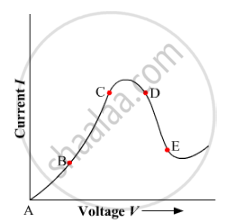
Graph showing the variation of current versus voltage for a material Ga As is shown in the figure. Identify the region of
(i) negative resistance
(ii) where Ohm's law is obeyed.
Write the formula of resistivity
An electric bulb draws 1.2 A current at 6.0 V. Find the resistance of filament of bulb while glowing.
Show by a diagram how two resistors R1 and R2 are joined in parallel. Obtain an expression for the total resistance of the combination.
The filament of a bulb takes a current 100 mA when potential difference across it is 0.2 V. When the potential difference across it becomes 1.0 V, the current becomes 400 mA. Calculate the resistance of filament in each case and account for the difference.
Rewrite the following statement by selecting the correct option.
The S.I. unit of resistance is __________.
SI unit of resistance is:
A student carries out an experiment and plots the V-I graph of three samples of nichrome wire with resistances R1, R2 and R3 respectively. Which of the following is true?

