Advertisements
Advertisements
प्रश्न
The relationship between the potential difference and the current in a conductor is stated in the form of a law.
1) Name the law.
2) What does the slope of V-I graph for a conductor represent?
3) Name the material used for making the connecting wire.
Advertisements
उत्तर
1) The relationship between the potential difference and the current in a conductor is given by Ohm’s law.
2) The slope of the V–I graph gives the resistance of the conductor.
Slope = `V/I = R`
3) The material used for making connecting wires is copper.
APPEARS IN
संबंधित प्रश्न
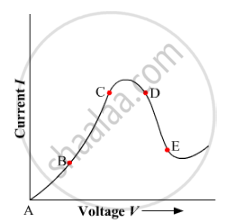
Graph showing the variation of current versus voltage for a material Ga As is shown in the figure. Identify the region of
(i) negative resistance
(ii) where Ohm's law is obeyed.
Will current flow more easily through a thick wire or a thin wire of the same material, when connected to the same source? Why?
What is Resistivity?
An electrical bulb is marked 200V, 100W. Calculate the electrical resistance of its filament. If five such
bulbs are connected in series to a 200V supply, how much current will flow through them?
Find the expression for the resistivity of a material and state the SI unit of resistivity.
The graph between V and I for a conductor is a straight line passing through the origin.
- Which law is illustrated by such a graph?
- What should remain constant in a statement of this law?
The graph between V and I for a conductor is a straight line passing through the origin.
What should remain constant in a statement of this law?
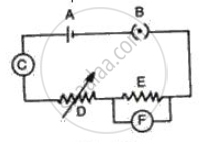
Fig. represents the circuit used for the verification of ohm's law. Label the different parts from A and F. State the function of each.
Define ampere and volt with respect to Ohm’s law.
The temperature of a conductor is increased. The graph best showing the variation of its resistance is:
