Advertisements
Advertisements
प्रश्न
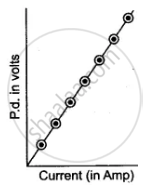
Draw a neat diagram for the verification of Ohm’s law by voltmeter-ammeter method. By another diagram show the relation between p.d. and current.
Advertisements
उत्तर

संबंधित प्रश्न
Will current flow more easily through a thick wire or a thin wire of the same material, when connected to the same source? Why?
The relationship between the potential difference and the current in a conductor is stated in the form of a law.
- Name the law.
- What does the slope of V-I graph for a conductor represent?
- Name the material used for making the connecting wire.
Write the SI unit of resistivity
An electric bulb draws 1.2 A current at 6.0 V. Find the resistance of filament of bulb while glowing.
What is non ohmic device?
Explain the equivalent resistance of a series resistor network.
What is the resistance of a conductor through which a current of 0.5 A flows when a potential difference of 2V is applied across its ends?
Why should an ammeter have low resistance?
The voltage - current readings of a certain material are shown in the table given below:
| Voltage (V) | 10 V | 20 V | 30 V |
| Current (I) | 2 A | 3 A | 4 A |
Study the table.
- State whether the conductor used is ohmic or non-ohmic.
- Justify your answer.
- State Ohm's law.
In the context of Ohm's Law, Current (I) is defined as:
