Advertisements
Advertisements
प्रश्न
The voltage - current readings of a certain material are shown in the table given below:
| Voltage (V) | 10 V | 20 V | 30 V |
| Current (I) | 2 A | 3 A | 4 A |
Study the table.
- State whether the conductor used is ohmic or non-ohmic.
- Justify your answer.
- State Ohm's law.
Advertisements
उत्तर
a. Here, the ratio of `V/1` for different readings is:
(i) `(10 V)/(2 A) = 5 Ω`
(ii) `(20 V)/(3 A) = 6.66 Ω`
(iii) `(30 V)/(4 A) = 7.5 Ω`
Here, the ratio is not constant, so the conductor is non-ohmic.
b. The ratio of `V/I` remains constant for all values of V and I in an ohmic conductor. Plotting current I against potential difference V results in a straight line that passes through the origin on a graph. Thus, the conductor in question is not ohmic.
c. Ohm's law states that, under constant physical conditions and conductor temperature, the current flowing in a conductor is directly proportional to the potential difference applied across its ends.
संबंधित प्रश्न
A low voltage supply from which one needs high currents must have very low internal resistance. Why?
Name the unit of electrical resistance and give its symbol.
Name the physical quantity whose unit is "ohm".
How much energy is consumed when a current of 5 amperes flows through the filament (or element) of a heater having resistance of 100 ohms for two hours? Express it in joules.
Which of the following is an ohmic resistance?
In the circuit shown in the figure, find the total resistance of the circuit and the current in the arm AD.
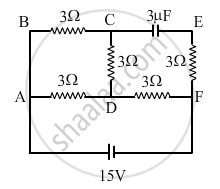
Calculate the electric field in a copper wire of cross-sectional area 2.0 mm2 carrying a current of 1 A.
The resistivity of copper = 1.7 × 10⁻⁸ Ω m
Ohm’s law states the relationship between power and voltage.
A wire connected to a power supply of 230 V has power dissipation P1. Suppose the wire is cut into two equal pieces and connected parallel to the same power supply. In this case, power dissipation is P2. The ratio of `"P"_2/"P"_1` is
When two conductors at different electric potentials are joined by a metallic wire, in which direction do the electrons flow?
