Advertisements
Advertisements
प्रश्न
Explain the equivalent resistance of a series resistor network.
Advertisements
उत्तर
When two or more resistors are connected end to end, they are said to be in series. The resistors could be simple resistors or bulbs or heating elements or other devices. Fig. (a) shows three resistors R1, R2 and R3 connected in series.
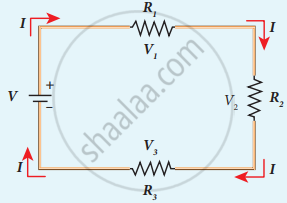
Three resistors in series
The amount of charge passing through resistor R1 must also pass through resistors R2 and R3 since the charges cannot accumulate anywhere in the circuit. Due to this reason, the current I passing through all the three resistors is the same. According to Ohm’s law, if same current pass through different resistors of different values, then the potential difference across each resistor must be different. Let V1, V2 and V3 be the potential difference (voltage) across each of the resistors R1, R2 and R3 respectively, then we can write V1 = IR1, V2 = IR2 and V3= IR3. But the total voltage V is equal to the sum of voltages across each resistor.
V = V1 + V2 + V3
= IR1 + IR2 + IR3 ….. (1)
V = I(R1 + R2 +R3)
V = I.RS …… (2)
where Rs = R1 + R2 R3 ……. (3)
When several resistances are connected in series, the total or equivalent resistance is the sum of the individual resistances as shown in the following figure.
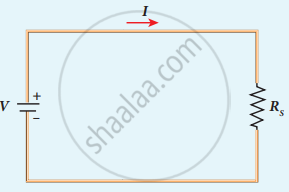
Equivalent resistance (RS) has the same current
APPEARS IN
संबंधित प्रश्न
What is an ohmic resistor? Give one example of an ohmic resistor. Draw a graph to show its current voltage relationship. How is the resistance of the resistor determined from this graph?
Which of the following is an ohmic resistance?
A wire of resistance 3 ohm and length 10 cm is stretched to length 30 cm. Assuming that it has a uniform cross section, what will be its new resistance?
In the circuit shown below in Fig, calculate the value of x if the equivalent resistance between A and B is 4 Ω.

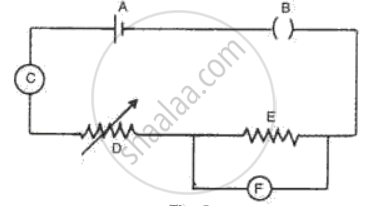
Fig. represents the circuit used for the verification of Ohm's law. Label the parts from A to F. state the function of each.
What is meant by the drift speed of free electrons?
What are ohmic conductors? Give one exmaple. Draw a graph showing the current-voltage relationship for an ohmic conductor.
What are non-ohmic conductors? Give one exmaple. Draw a current-voltage graph for a non-ohmic conductor.
A current of 3.2 mA flows through a conductor. If charge on an electron is −1.6 × 10⁻¹⁹ coulomb, find the number of electrons that will pass each second through the cross section of that conductor.
Which of the following correctly defines Potential Difference (V) as one of the three core quantities of Ohm's Law?
