Advertisements
Advertisements
प्रश्न
Obtain the macroscopic form of Ohm’s law from its microscopic form and discuss its limitation.
Advertisements
उत्तर
- Consider a segment of wire of length l and area of cross-section A
- Electric field is created when a potential difference V is applied
- If ‘E’ is uniform, then, V = El
- Current density, J = σ E = σ`"V"/l`
Since J = `"I"/"A"`
`"I"/"A" = sigma "V"/l`
Rearranging the above equation, Current through the conductor

Current through the conductor
V = `"I"(l/(sigma"A"))`
Where `(l/(sigma"A"))` → resistance of conductor (R)
∴ R `alpha (l/(sigma"A"))`
∴ The macroscopic form of Ohm's law is
V = IR ...[V α I]
Limitations:
There are certain materials and devices where the proportionality of V and I does not hold good.
APPEARS IN
संबंधित प्रश्न
When a 12 V battery is connected across an unknown resistor, there is a current of 2.5 mA in the circuit. Find the value of the resistance of the resistor.
Write the SI unit of resistivity
What is the necessary condition for a conductor to obey Ohm’s law?
What length of copper wire of resistivity 1.7 × 10⁻⁸ Ω m and radius 1 mm is required so that its resistance is 2Ω?
What is ohmic device?
An electronics hobbyist is building a radio which requires 150 Ω in her circuit, but she has only 220 Ω, 79 Ω, and 92 Ω resistors available. How can she connect the available resistors to get the desired value of resistance?
Ohm's law deals with the relationship between ______
How is electric current related to the potential difference across the terminals of a conductor?
Draw a labelled circuit diagram to verify this relationship.
The circuit depicted in the figure is employed for studying Ohm’s Law. Instead of using a standard resistor, a student opts for a glass tube filled with mercury (tube 1), connected to the circuit through two electrodes, E1 and E2. He records the readings of the ammeter and voltmeter, thereby calculating the resistance. The student repeats the experiment by substituting tube 1 with tube 2, where the same amount of mercury fills tube 2.
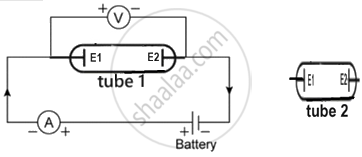
Neglecting internal resistance of the cell use (> or < or =) to compare:
- the resistance in both the cases.
- the voltmeter readings in both the cases.
- the specific resistance in both the cases.
Which of the following is an example of a Non-Ohmic material?
