Advertisements
Advertisements
प्रश्न
Obtain the macroscopic form of Ohm’s law from its microscopic form and discuss its limitation.
Advertisements
उत्तर
- Consider a segment of wire of length l and area of cross-section A
- Electric field is created when a potential difference V is applied
- If ‘E’ is uniform, then, V = El
- Current density, J = σ E = σ`"V"/l`
Since J = `"I"/"A"`
`"I"/"A" = sigma "V"/l`
Rearranging the above equation, Current through the conductor

Current through the conductor
V = `"I"(l/(sigma"A"))`
Where `(l/(sigma"A"))` → resistance of conductor (R)
∴ R `alpha (l/(sigma"A"))`
∴ The macroscopic form of Ohm's law is
V = IR ...[V α I]
Limitations:
There are certain materials and devices where the proportionality of V and I does not hold good.
APPEARS IN
संबंधित प्रश्न
The resistors R1, R2, R3 and R4 in the figure given below are all equal in value.
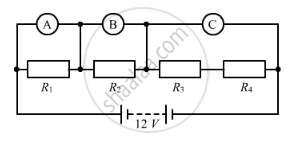
What would you expect the voltmeter A, B and C to read assuming that the connecting wires in the circuit have negligible resistance?
In a conductor 6.25 × `10^16` electrons flow from its end A to B in 2 s. Find the current flowing through the conductor (e = 1.6 × `10^-19` C)
Calculate the current flowing through a wire of resistance 5 Ω connected to a battery of potential difference 3 V.
Two metallic spheres A and B kept on insulating stands are in contact with each other. A positively charged rod P is brought near the sphere A as shown in the figure. The two spheres are separated from each other, and the rod P is removed. What will be the nature of charges on spheres A and B?
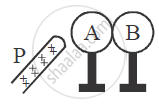
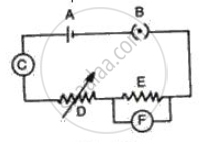
Fig. represents the circuit used for the verification of ohm's law. Label the different parts from A and F. State the function of each.
An ammeter placed in series with an electric radiator reads 0.5 amps and a voltmeter placed across it reads 230 volts. What is the resistance of the radiator?
Which of the following I-V graph represents ohmic conductors?
Consider a current carrying wire (current I) in the shape of a circle. Note that as the current progresses along the wire, the direction of j (current density) changes in an exact manner, while the current I remain unaffected. The agent that is essentially responsible for is ______.
What is the resistance of a conductor through which a current of 0.5 A flows when a potential difference of 2V is applied across its ends?
In the context of Ohm's Law, Current (I) is defined as:
