Advertisements
Advertisements
प्रश्न
The unit of electrical resistance is:
(a) ampere
(b) volt
(c) coulomb
(d) ohm
Advertisements
उत्तर
(d) ohm
The unit of electrical resistance is ohm.
APPEARS IN
संबंधित प्रश्न
Find the resistance of a conductor if 0.24 A current is passing through it and a potential difference of 24 V is applied across it.
An electrical bulb is marked 200V, 100W. Calculate the electrical resistance of its filament. If five such
bulbs are connected in series to a 200V supply, how much current will flow through them?
Ohm's law gives a relationship between:
(a) current and resistance
(b) resistance and potential difference
(c) potential difference and electric charge
(d) current and potential difference
How should the two resistances of 2 ohms each be connected so as to produce an equivalent resistance of 1 ohm?
A wire of resistance 3 ohm and length 10 cm is stretched to length 30 cm. Assuming that it has a uniform cross section, what will be its new resistance?
The ratio of the potential difference to the current is known as ________.
Explain the equivalent resistance of a series resistor network.
The resistance of a nichrome wire at 0°C is 10Ω. If its temperature coefficient of resistivity of nichrome is 0.004/ °C, find its resistance of the wire at boiling point of water. Comment on the result.
The temperature of a conductor is increased. The graph best showing the variation of its resistance is:
Assertion: The statement of Ohm’s law is K = IR.
Reason: V = IR is the equation which defines resistance.
A heater of 220 V heats a volume of water m 5 mint time. A heater of 110 V heat in ten second. The resistance of the conductor is
A metal rod of length 10 cm and a rectangular cross-section of 1 cm × `1/2` cm is connected to a battery across opposite faces. The resistance will be ______.
Two cells of same emf E but internal resistance r1 and r2 are connected in series to an external resistor R (Figure). What should be the value of R so that the potential difference across the terminals of the first cell becomes zero.
Suppose there is a circuit consisting of only resistances and batteries and we have to double (or increase it to n-times) all voltages and all resistances. Show that currents are unaltered. Do this for circuit of Example 3.7 in the NCERT Text Book for Class XII.
The resistance of a resistor is reduced to half of its initial value. If other parameters of the electrical circuit remain unaltered, the amount of heat produced in the resistor will become ______.
Why should an ammeter have low resistance?
The voltage - current readings of a certain material are shown in the table given below:
| Voltage (V) | 10 V | 20 V | 30 V |
| Current (I) | 2 A | 3 A | 4 A |
Study the table.
- State whether the conductor used is ohmic or non-ohmic.
- Justify your answer.
- State Ohm's law.
The circuit depicted in the figure is employed for studying Ohm’s Law. Instead of using a standard resistor, a student opts for a glass tube filled with mercury (tube 1), connected to the circuit through two electrodes, E1 and E2. He records the readings of the ammeter and voltmeter, thereby calculating the resistance. The student repeats the experiment by substituting tube 1 with tube 2, where the same amount of mercury fills tube 2.
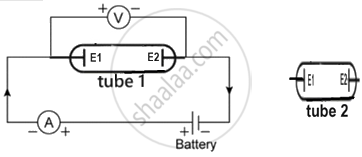
Neglecting internal resistance of the cell use (> or < or =) to compare:
- the resistance in both the cases.
- the voltmeter readings in both the cases.
- the specific resistance in both the cases.
Which of the following correctly defines Potential Difference (V) as one of the three core quantities of Ohm's Law?
Which of the following describes the V-I relation for an Ohmic conductor?
