Advertisements
Advertisements
प्रश्न
The substance having infinitely high electrical resistance is called:
(a) conductor
(b) resistor
(c) superconductor
(d) insulator
Advertisements
उत्तर
(d) insulator
A substance having infinitely high electrical resistance is called an insulator.
APPEARS IN
संबंधित प्रश्न
Give the law of combination of resistances in series.
Two resistances X and Y are connected turn by turn:
- in parallel, and
- in series.
In which case the resultant resistance will be less than either of the individual resistances?
A p.d. of 4 V is applied to two resistors of 6 Ω and 2 Ω connected in series. Calculate:
(a) the combined resistance
(b) the current flowing
(c) the p.d. across the 6 Ω resistor
You are supplied with a number of 100 Ω resistors. How could you combine some of these resistors to make a 250 Ω resistor?
In series combination of resistances ______.
To increase the effective resistance in a circuit, the resistors are connected in _______________ .
When do you say that the resistors are connected in this way? Draw a circuit diagram.
Bends in a rubber pipe reduce the flow of water through it. How would the bands in a wire affect its electric resistance?
Name the material of wire used for making standard resistances. Give a reason.
You are provided with three resistors of resistance 1.0 Ω, 2.0 Ω and 3.0 Ω How would you connect them to obtain the total effective resistance 1.5 Ω? Draw diagram of the arrangement and check it by calculations.
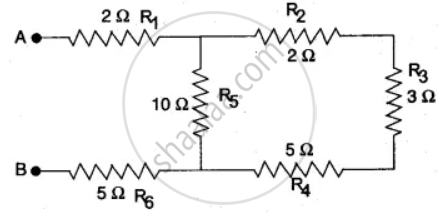
Six resistances are connected together as shown in the figure. Calculate the equivalent resistance between points A and B.
What is the equivalent resistance between the points X and Y for the given network?
2Ω resistor A, 1Ω resistor B and 4Ω resistor C are connected in parallel. The combination is connected across a 2V battery of negligible resistance. Draw the diagram of the arrangement and calculate:
(i) The current in each resistor A and C,
(ii) The current through battery.
Two wires of same material and same lengths have radii in the ratio of 2 : 3, Compare their resistances.
Two resistors having 2Ω and 3Ω resistance are connected—(i) in series, and (ii) in parallel. Find the equivalent resistance in each case.
