Advertisements
Advertisements
प्रश्न
2Ω resistor A, 1Ω resistor B and 4Ω resistor C are connected in parallel. The combination is connected across a 2V battery of negligible resistance. Draw the diagram of the arrangement and calculate:
(i) The current in each resistor A and C,
(ii) The current through battery.
Advertisements
उत्तर
The diagram of the arrangement is shown in given figure.
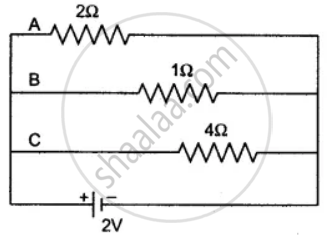
(i) The current in resistor A is I1 = `"V"/"R"_1 = 2/2 = 1.0`A
The current in resistor B is I2 = `"V"/"R"_2 = 2/1 = 2.0`A
The current in resistor B is I3 = `"V"/"R"_3 = 2/4 = 0.5`A
(ii) The current through battery
I = I1 + I2 + I3
I = 1.0 + 2.0 + 0.5
= 3.5 Ampere.
संबंधित प्रश्न
Judge the equivalent resistance when the following are connected in parallel − (a) 1 Ω and 106Ω, (b) 1 Ω and 103Ω and 106Ω.
To increase the effective resistance in a circuit, the resistors are connected in _______________ .
Why are thick copper wires used as connecting wires?
With the help of a circuit diagram derive the formula for the resultant resistance of three resistances connected:
- in series and
- in parallel
In an electrical circuit, two resistors of 2 Ω and 4 Ω respectively are connected in series to a 6 V battery. The heat dissipated by the 4 Ω resistor in 5 s will be ______.
Consider the following combinations of resistors:


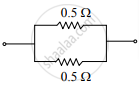
The combinations having equivalent resistance 1 Q is/are ______.
