Advertisements
Advertisements
प्रश्न
2Ω resistor A, 1Ω resistor B and 4Ω resistor C are connected in parallel. The combination is connected across a 2V battery of negligible resistance. Draw the diagram of the arrangement and calculate:
(i) The current in each resistor A and C,
(ii) The current through battery.
Advertisements
उत्तर
The diagram of the arrangement is shown in given figure.
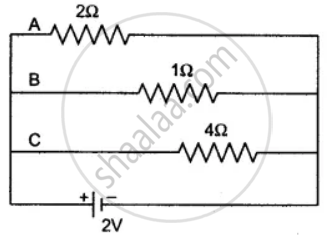
(i) The current in resistor A is I1 = `"V"/"R"_1 = 2/2 = 1.0`A
The current in resistor B is I2 = `"V"/"R"_2 = 2/1 = 2.0`A
The current in resistor B is I3 = `"V"/"R"_3 = 2/4 = 0.5`A
(ii) The current through battery
I = I1 + I2 + I3
I = 1.0 + 2.0 + 0.5
= 3.5 Ampere.
संबंधित प्रश्न
Find the expression for the resistors connected in series and write the two characteristics of it. (Draw figure).
How does the resistance of a pure metal change if its temperature decreases?
Two resistances X and Y are connected turn by turn:
- in parallel, and
- in series.
In which case the resultant resistance will be less than either of the individual resistances?
Calculate the combined resistance in the given case:

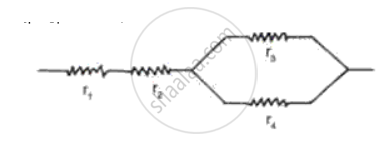
Calculate the equivalent resistance of the following combination of resistor r1, r2, r3, and r4
Why are thick copper wires used as connecting wires?
Calculate the equivalent resistance between the points A and B for the following combination of resistors:
Six equal resistors of 1 ohm each are connected to form the sides of a hexagon ABCDEF. Calculate the resistance offered by the combination if the current enters at A and leaves it at D.
What should be the length of a nickel wire of area of cross-section 3 mm2 used for making a rheostat of 750 ohm? (ρ of nickle = 0.069 Ohm mm2/m)
If R1 and R2 be the resistance of the filament of 40 W and 60 W respectively operating 220 V, then:
