Advertisements
Advertisements
प्रश्न
Calculate the equivalent resistance between the points A and B for the following combination of resistors:
Advertisements
उत्तर
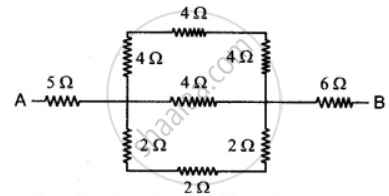
`1/("R"_1') = 1/12 + 1/4 + 1/6 = (1 + 3 + 2)/12 = 6/12`
`1/("R"_1') = 1/2`
R1' = 2 Ω
Total resistance = 5 + 2 + 6 = 13 ohm.
संबंधित प्रश्न
How does the resistance of a wire change when:
its diameter is tripled?
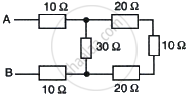
What is the resistance between A and B in the figure given below?
In series combination of resistances ______.
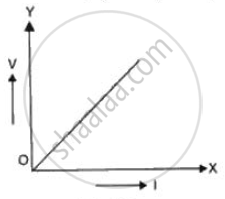
A graph is plotted taking p.d. along y-axis and electric current along x-axis. Name the physical quantity that represents the slope of this graph (Fig.).
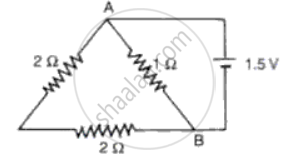
What is the equivalent resistance between A and B in the given circuit (Fig?)
Two bulbs of 100 W and 40 W are connected in series. The current through the 100 W bulb is 1 A. The current through the 40 W bulb will be ______.
What material is used for making wire to prepare heating coils? Give a reason.
How does the resistivity of an alloy such as constantace depends on temperature.
